



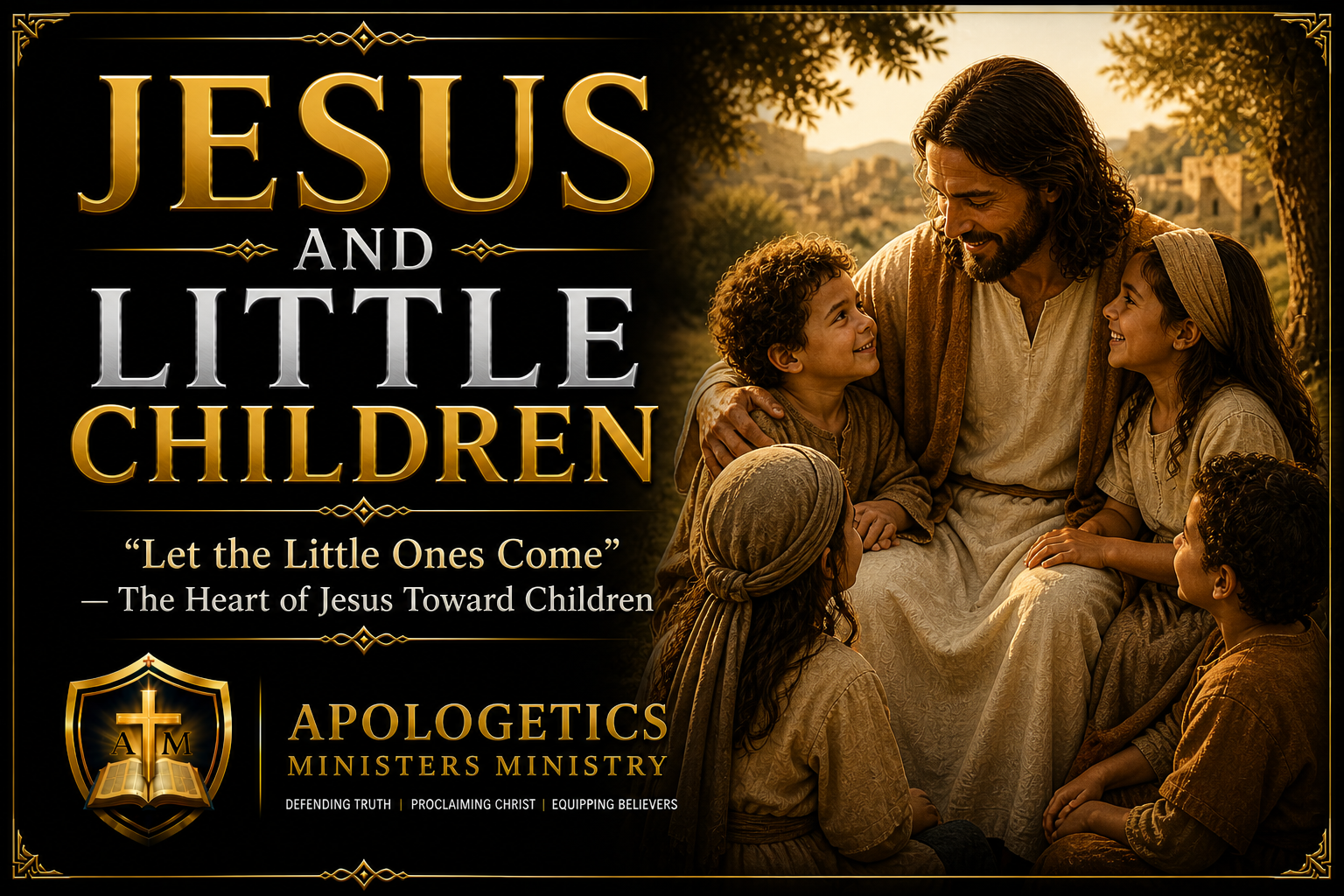

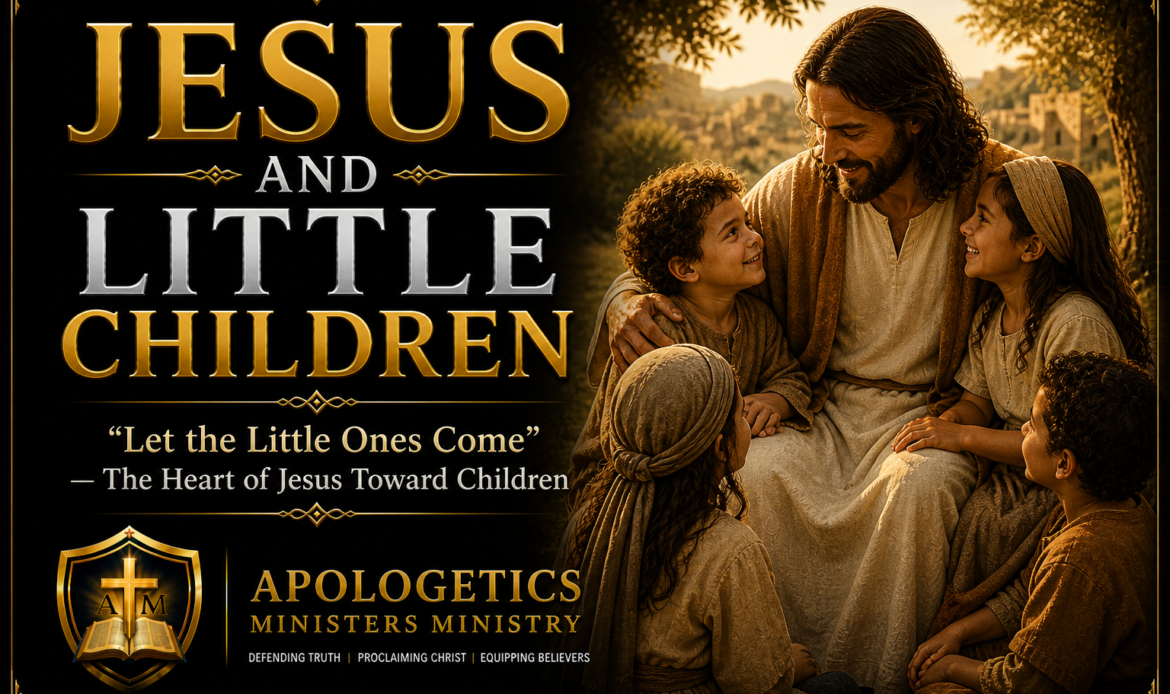
JESUS AND LITTLE CHILDREN
“Let the Little Ones Come” — The Heart of Jesus Toward Children.
Matthew 19:14
There are moments in Scripture that feel like windows, where eternity cracks open just enough for us to glimpse the heart of God. One of the clearest of these windows appears when Jesus interacts with children. In a culture that often overlooked them, Jesus did something revolutionary: He placed a child at the center of divine revelation. His words and actions regarding children do not merely reveal His tenderness; they reveal His kingdom. They show us what God values, expects, and requires from all who hope to walk with Him.
To understand how Jesus viewed children—and what He commands us to do with them—we must step into the world of the Gospel narratives, especially the scenes found in Matthew 19:13–15, Mark 10:13–16, and Matthew 18:1–6. What emerges from these passages is a portrait of Christ that is both gentle and authoritative, both tender and deeply instructive.
1. Children in the Arms of Christ
Matthew tells us that people began bringing children to Jesus so that He might lay His hands on them and pray for them. It was a simple request—parents seeking a blessing from a holy teacher. Yet the disciples, perhaps believing they were protecting Jesus from distraction, rebuked the parents. From their perspective, children were too insignificant, too small to warrant the time of the Messiah. But Jesus’ reaction exposed a different value system.
“Let the little children come to me, and do not hinder them, for the kingdom of heaven belongs to such as these.”
This statement is not merely gentle; it is radical. Jesus invites children into His presence without hesitation. He welcomes them with joy. He lays His hands on them, blesses them, and honors them.
But notice something deeper: He does not bless the children for the sake of the adults; He blesses them for their own sake. Children are not props in God’s story—they are people, known and loved individually.
In this moment, Jesus is establishing a new way of seeing childhood. To Him, children are not interruptions; they are illustrations. Not future members of the kingdom—but present ones. Not weak bodies to be managed—but pure mirrors of how faith works.
2. Children as the Pattern of the Kingdom
In another scene, the disciples approached Jesus with an ambitious question: “Who is the greatest in the kingdom of heaven?” They expected talk of spiritual giants or heroic faith. But Jesus responded in a way that must have shocked everyone present. He called a little child to Himself, placed the child in their midst, and said:
“Unless you become like little children, you will never enter the kingdom of heaven.”
This is not poetic exaggeration. This is divine requirement.
Children, in Jesus’ teaching, represent:
Dependence — They cannot survive alone.
Trust — They believe without complication.
Humility — They do not pretend to be more than they are.
Purity of heart — They approach without guile or hidden motives.
Receptivity — Their hearts are open, unguarded, ready to receive.
Jesus is pressing a truth into His disciples: Heaven is not earned by power but entered through childlike humility. Child-likeness is not childishness; it is a soul returned to the simplicity of trusting God.
Thus, Jesus is teaching us two things at the same time:
1. How we ought to be toward God,
2. And how we ought to treat those who embody these virtues—children.
3. A Warning from the Compassionate Christ
One of the strongest warnings Jesus ever issued is connected to children. He said:
“Whoever causes one of these little ones who believe in me to stumble, it would be better for him to have a millstone hung around his neck and be drowned in the depths of the sea.”
This is a stunning pronouncement. Jesus rarely spoke in such severe terms. Yet when it came to children, His tone sharpened—not because He was cruel, but because He was a Shepherd defending His lambs.
In these words we see:
The Value of Children in the Eyes of God
They are treasures of the kingdom, and harming them is a direct offense against heaven.
The Vulnerability of Children
Their hearts are open; therefore they can be deeply shaped—for good or for evil.
The Responsibility of Adults
We are guardians, not merely observers. We are stewards, not simply bystanders.
Jesus places the protection, nurture, and spiritual formation of children at the very center of His ethical teaching. To mislead them is not simply wrong—it is a spiritual crime of the highest order.
4. What Jesus Commands Us to Do with Children
Based on His actions and teachings, Jesus gives us a clear blueprint:
1. Bring them to Him
Do not hinder their access to God.
This means teaching them the Scriptures, praying with them, modeling godliness in the home, and creating an environment where faith can grow naturally.
2. Bless them
Jesus laid His hands on children and prayed for them.
Every child needs affirmation, encouragement, and spiritual blessing—spoken over them with intention.
3. Protect them
In body, mind, and soul.
Protection is not simply keeping harm away; it is guiding them away from influences that corrupt, ideologies that deform, and experiences that wound.
4. Learn from them
Children are not only to be taught; they are teachers themselves. Their purity, honesty, trust, and tenderness reveal the posture required to walk with God.
5. Value them as God values them
Jesus placed a child in the center of a theological conversation.
He elevated childhood to a place of sacred significance.
To follow Him is to carry the same attitude.
. The Call of Christ to Our Generation
We live in a world where children are often overlooked, exploited, or spiritually neglected. Jesus’ words ring louder than ever:
“Do not hinder them.”
Do not hinder them through:
A home without spiritual nourishment
A culture that corrupts innocence
A society that fails to protect
An education without truth
A church without space for the young
Jesus calls us to open the way—to guide the youngest among us into His light.
In the arms of Jesus, children found rest. In His voice, they found blessing. In His kingdom, they found a home. And in their innocence, Jesus found the perfect example of what every human soul must become.
To follow Jesus is to welcome children.
To love Jesus is to love them.
To serve Jesus is to shape their lives with truth, tenderness, and protection.
When Jesus said, “Let the little children come to me,” He wasn’t giving a suggestion.
He was revealing the heartbeat of God.
Hadith literature also shows that Aisha herself struggled to understand certain aspects of her situation. Sahih al-Bukhari reports that she was taken suddenly from play to marriage, indicating lack of maturity and preparation (Sahih al-Bukhari 3894). These details reinforce the concern that this was not a relationship between equals, but between authority and vulnerability.
Christian theology insists that God’s holiness never contradicts the protection of children. God does not grant special moral permission to prophets that He denies to everyone else. Scripture teaches that God is the same yesterday, today, and forever, and His moral nature does not change. Any claim of revelation that appears to permit what Scripture consistently condemns must be questioned.
Jesus Christ stands in complete contrast. He never married, never used authority to satisfy personal desire, and never blurred the line between power and purity. He lifted the moral standard, teaching that even lust in the heart is sinful. His treatment of women was marked by dignity, protection, and respect, never exploitation. His treatment of children was marked by tenderness and warning against harm.
This issue therefore goes to the heart of prophetic credibility. A true prophet does not lower moral standards; he calls people higher. He does not place the vulnerable at risk; he protects them. He does not ask the world to imitate actions that trouble the conscience; he points the conscience toward holiness.
Muhammad’s marriage to Aisha cannot be dismissed as irrelevant or misunderstood. It is clearly recorded, widely accepted in Islamic tradition, and deeply influential. When examined by biblical standards of holiness, protection of children, and moral leadership, it raises serious and unavoidable questions.
Christian faith does not rest on the private life of a single man hidden from scrutiny. It rests on a public Savior, a sinless life, a sacrificial death, and a resurrection witnessed by many. The difference between these foundations is profound, and it matters.