


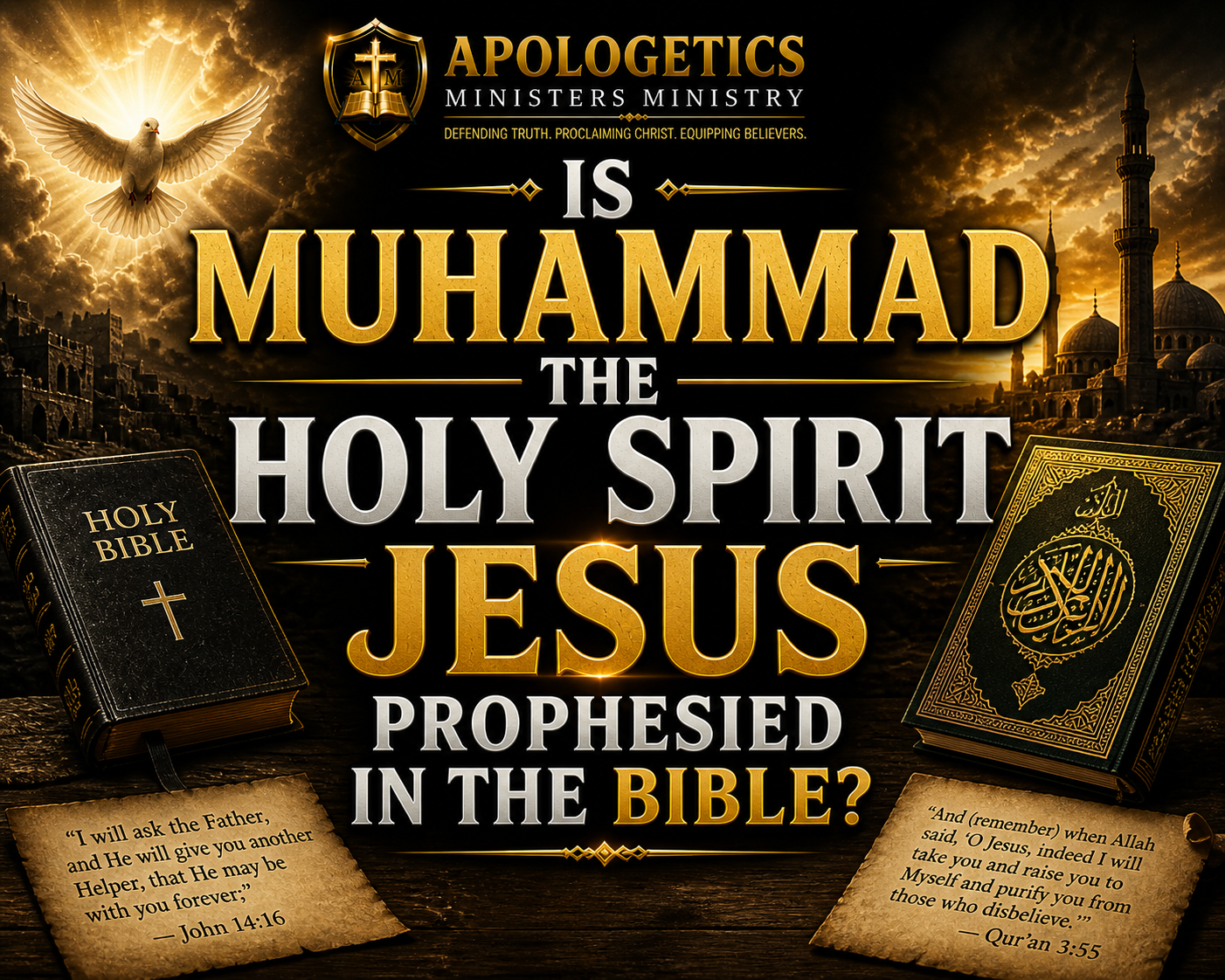

IS MUHAMMAD THE HOLY SPIRIT JESUS PROPHESIED IN THE BIBLE?
A Deep Comparative Study of Scripture, Theology, and Interpretation
Introduction
Few interfaith questions generate as much debate as this one: Did Jesus Christ actually prophesy the coming of Muhammad—and if so, is that figure the same as the Holy Spirit described in the Bible?
This question is not merely academic. It touches on the authority of revelation, the continuity of prophecy, and the identity of divine guidance in both Christianity and Islam. For Christians, the Holy Spirit is central to the life of the Church and the fulfillment of Jesus’ promise. For Muslims, Muhammad is the final messenger, and some interpret certain biblical passages as foretelling his coming.
However, the specific claim that Muhammad is the Holy Spirit Jesus promised is far more controversial—and, as we will see, difficult to sustain when examined carefully.
This article will explore the issue in depth, drawing from both the Bible and the Qur’an, while engaging historical interpretation, linguistic analysis, and theological reasoning.
1. The Promise of the Comforter in the Gospel of John
The foundation of this discussion lies in the farewell discourse of Jesus in the Gospel of John (chapters 14–16). In these passages, Jesus promises the coming of a figure often translated as the “Comforter,” “Helper,” or “Advocate.”
One of the clearest statements is:
“But the Comforter, which is the Holy Ghost, whom the Father will send in my name, he shall teach you all things…” (John 14:26)
This verse is crucial because it explicitly identifies the Comforter as the Holy Spirit.
Key Greek Term: Paraklētos
The original Greek word used is Paraklētos, which means:
Advocate
Helper
Counselor
One called alongside
In the context of the Gospel, this figure is not introduced as a human prophet but as a divine presence continuing Jesus’ work.
2. Characteristics of the Holy Spirit in the Bible
To evaluate whether Muhammad could be the Holy Spirit, we must first understand how the Bible describes the Holy Spirit.
A. The Holy Spirit is Divine
In the New Testament, the Holy Spirit is not merely a messenger but is associated with God Himself.
Acts 5:3–4 equates lying to the Holy Spirit with lying to God
The Spirit participates in creation (Genesis 1:2)
The Spirit empowers prophets and believers
B. The Holy Spirit Indwells Believers
Jesus says:
“He dwelleth with you, and shall be in you.” (John 14:17)
This is a defining feature. The Holy Spirit is not external only—He lives within believers.
No human prophet, including Muhammad, is ever described in such terms.
C. The Holy Spirit is Present Immediately After Jesus
According to the New Testament:
The Holy Spirit comes at Pentecost (Acts 2)
This occurs shortly after Jesus’ ascension
The disciples receive power and begin preaching
This timeline is important. Muhammad appears approximately six centuries later, which creates a chronological gap difficult to reconcile with Jesus’ promise of an imminent helper.
3. The Islamic Perspective: Muhammad Foretold by Jesus
The Qur’an presents a different perspective:
“And [remember] when Jesus, son of Mary, said: ‘O Children of Israel, indeed I am the messenger of Allah to you… giving glad tidings of a messenger to come after me, whose name is Ahmad.’” (Qur’an 61:6)
Here, Jesus is said to have foretold a future messenger named Ahmad, which is understood to refer to Muhammad.
Important Distinction
The Qur’an does not say:
Ahmad is the Holy Spirit
Ahmad is divine
Ahmad dwells in believers
Rather, Ahmad is clearly described as a human messenger.
This alone suggests that equating Muhammad with the Holy Spirit is not even required—or supported—within Islamic theology itself.
4. The Paraclete Argument in Muslim Apologetics
Some Muslim apologists argue that the “Comforter” in John is actually a prophecy of Muhammad.
The Argument:
The Greek word Paraklētos is claimed to be a corruption of Periklutos
Periklutos means “praised one,” similar to Ahmad
Therefore, Jesus was predicting Muhammad
The Problem:
There is no manuscript evidence for this claim.
All known Greek manuscripts—dating back to early Christianity—consistently use Paraklētos.
This means:
The argument is speculative
It relies on a hypothetical textual change without evidence
It is not supported by historical textual criticism
5. Comparing Muhammad and the Holy Spirit
Let’s examine the differences more directly.
Nature
Holy Spirit: Spiritual, invisible, divine presence
Muhammad: Human being, born in Mecca, lived a historical life.
Function
Holy Spirit: Indwells believers, teaches internally
Muhammad: Preaches externally, delivers revelation
Timing
Holy Spirit: Comes shortly after Jesus (Acts 2)
Muhammad: Appears ~600 years later
Mode of Operation
Holy Spirit: Works within hearts
Muhammad: Brings a scripture and legal system
These differences are not minor—they are foundational.
6. Could the Holy Spirit Be a Human Being?
To argue that Muhammad is the Holy Spirit, one would have to redefine the Holy Spirit as a human prophet.
However, this creates several contradictions:
A. Biblical Contradiction
The Bible consistently describes the Spirit as:
Non-human
Omnipresent
Indwelling
B. Logical Issue
If the Holy Spirit is a human:
How can He be present in millions of believers at once?
How can He dwell “within” people?
C. Islamic Contradiction
In Islam, the Holy Spirit is typically identified with Jibreel (Gabriel), not Muhammad.
So even within Islamic theology, Muhammad ≠ Holy Spirit.
7. The Role of the Holy Spirit vs. the Role of Muhammad
Understanding each role helps clarify the distinction.
Holy Spirit in Christianity
Comforts believers
Guides into truth
Convicts of sin
Glorifies Christ
Muhammad in Islam
Final prophet
Receiver of the Qur’an
Lawgiver and leader
Messenger to humanity
These roles operate in entirely different categories:
One is divine presence
The other is human messenger
8. Why the Confusion Happens
The confusion often arises because both traditions speak of:
Guidance
Truth
A figure sent after Jesus
But similarity in function does not equal identity.
It is like saying:
A teacher and a textbook both teach
But they are not the same thing
9. A More Accurate Framing
A more intellectually consistent argument (from an Islamic perspective) is:
Jesus foretold a future messenger (Qur’an 61:6)
That messenger is Muhammad
The Bible’s Paraclete passages may be interpreted symbolically or differently
This avoids the problematic claim that Muhammad is the Holy Spirit.
10. Conclusion
After examining the texts carefully, the conclusion becomes clear:
The Bible identifies the Comforter explicitly as the Holy Spirit
The Holy Spirit is described as divine, indwelling, and immediate after Jesus
Muhammad is a human prophet who appears centuries later
The Qur’an presents Muhammad as a messenger—not as the Holy Spirit
Therefore, the claim that Muhammad is the Holy Spirit Jesus prophesied does not hold up under biblical, historical, or even Qur’anic scrutiny.
Final Reflection
Interfaith dialogue benefits from clarity rather than forced equivalence. Both Christianity and Islam have rich, coherent theological systems—but they do not always align.
Understanding these differences honestly:
Strengthens meaningful dialogue
Prevents misrepresentation
Encourages deeper study
If one wishes to argue that Muhammad was foretold by Jesus, that is a separate discussion. But identifying him as the Holy Spirit introduces contradictions that neither scripture supports.
Comments (5)
Olanrewaju Ogunmokun - May 4, 2026
Mohamed can never be the comforter that Jesus promise if so why he preach again Jesus, why he ordered to kill the Jews
Thomas Michael - May 4, 2026
Jesus is the only way
Raji Bola - May 4, 2026
Thanks so much for this great eyes opening!!
This is worth reading expecially those who are getting confused about who Muhammad is and who the Holy Spirit is.
It’s clear that Muhammad can never be the Holy Spirit.
God bless you richly
Damilare - May 4, 2026
How can Muhammad be holy Spirit when the work of the spirit is to remember the teaching of Christ to believers and to affirm the death and resurrection of Jesus but in contrary Muhammad is against the work of salvation in Christ Jesus
Medupin Omotehinse - May 14, 2026
It’s only a moron or imbecile that will say Mohammed is the Holy Spirit the difference and distinction is clear, Mohammed is Mohammed, Holy Spirit is Holy Spirit no comparison between them. While Holy Spirit is a Comforter and life giver, Mohammed is an agent of death. Muslims are trying to squeeze their Mohammed into the Bible, but they can’t do it and their lies has been exposed globally. Jesus reigns, hallelujah.