



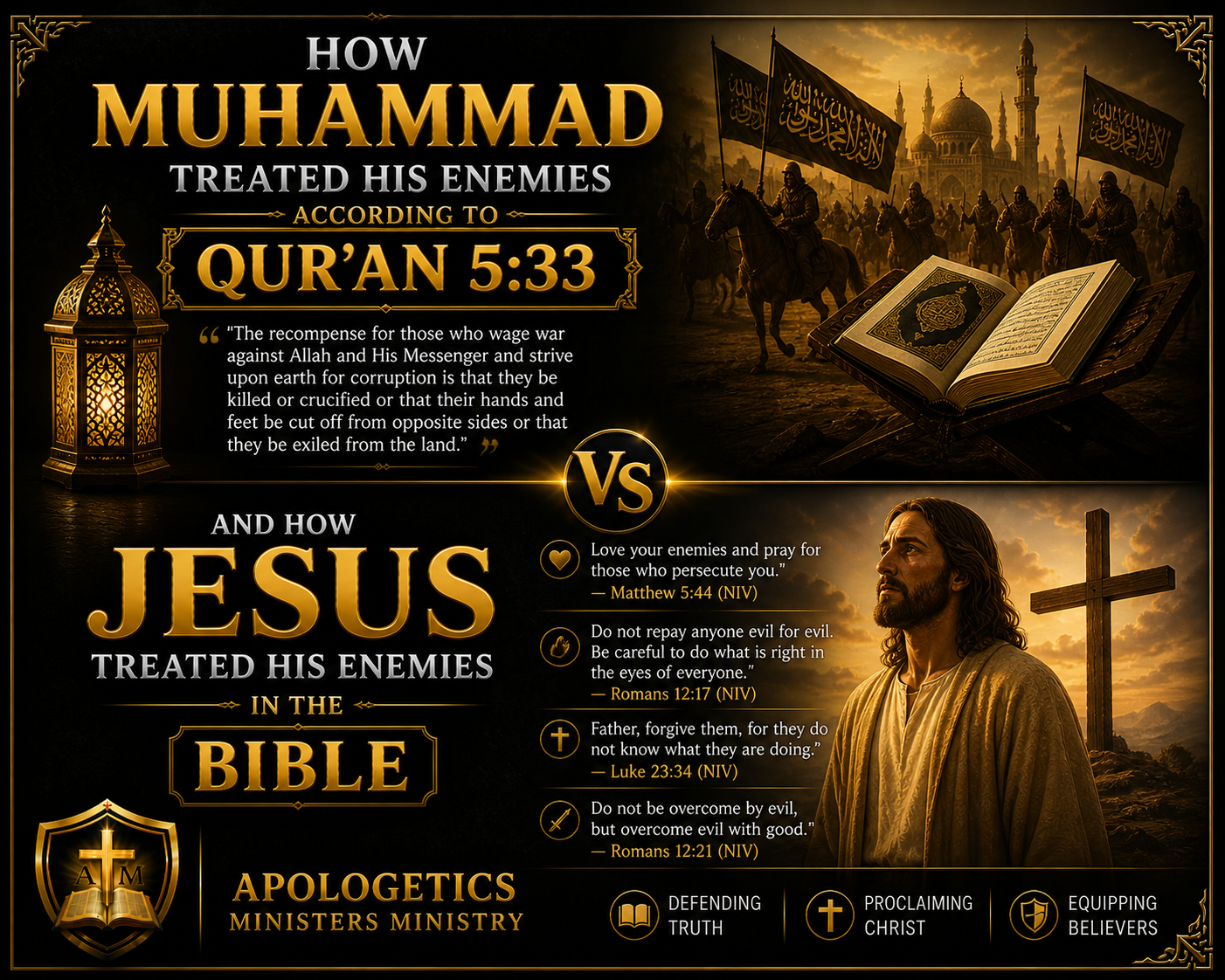

HOW MUHAMMAD TREATED HIS ENEMIES ACCORDING TO QUR’AN 5:33
AND HOW JESUS TREATED HIS ENEMIES IN THE BIBLE
Quran 5:33
Arabic
إِنَّمَا جَزَٰٓؤُا۟ ٱلَّذِينَ يُحَارِبُونَ ٱللَّهَ وَرَسُولَهُۥ وَيَسْعَوْنَ فِى ٱلْأَرْضِ فَسَادًا أَن يُقَتَّلُوٓا۟ أَوْ يُصَلَّبُوٓا۟ أَوْ تُقَطَّعَ أَيْدِيهِمْ وَأَرْجُلُهُم مِّنْ خِلَٰفٍ أَوْ يُنفَوْا۟ مِنَ ٱلْأَرْضِ ۚ ذَٰلِكَ لَهُمْ خِزْىٌ فِى ٱلدُّنْيَا ۖ وَلَهُمْ فِى ٱلْءَاخِرَةِ عَذَابٌ عَظِيمٌ
Sahih Intl
Indeed, the penalty for those who wage war against Allah and His Messenger and strive upon earth [to cause] corruption is none but that they be killed or crucified or that their hands and feet be cut off from opposite sides or that they be exiled from the land. That is for them a disgrace in this world; and for them in the Hereafter is a great punishment,
TAFSIR IBN KATHIR VOLUME 3 PAGE 162-163
The recompense of those who wage war against Allah and His Messenger and do mischief in the land…) “Was revealed concerning the idolators, those among them who repent before being apprehended, they will still be liable for punishment for the crimes they committed.” The correct opinion is that this Ayah is general in meaning and includes the idolators and all others who commit the types of crimes the Ayah mentioned. Al-Bukhari and Muslim recorded that Abu Qilabah `Abdullah bin Zayd Al-Jarmi, said that Anas bin Malik said, “Eight people of the `Ukl tribe came to the Messenger of Allah and gave him their pledge to follow Islam. Al-Madinah’s climate did not suit them and they became sick and complained to Allah’s Messenger. So he said,
(Go with our shephard to be treated by the milk and urine of his camels.) So they went as directed, and after they drank from the camels’ milk and urine, they became healthy, and they killed the shepherd and drove away all the camels. The news reached the Prophet and he sent (men) in their pursuit and they were captured. He then ordered that their hands and feet be cut off (and it was done), and their eyes were branded with heated pieces of iron. Next, they were put in the sun until they died.” This is the wording of Muslim. In another narration for this Hadith, it was mentioned that these people were from the tribes of `Ukl or `Uraynah. Another narration reported that these people were put in the Harrah area (of Al-Madinah), and when they asked for water, no water was given to them
Sahih al-Bukhari 6805
Narrated Anas bin Malik:
A group of people from `Ukl (or `Uraina) tribe —-but I think he said that they were from `Ukl came to Medina and (they became ill, so) the Prophet (ﷺ) ordered them to go to the herd of (Milch) she-camels and told them to go out and drink the camels’ urine and milk (as a medicine). So they went and drank it, and when they became healthy, they killed the shepherd and drove away the camels. This news reached the Prophet (ﷺ) early in the morning, so he sent (some) men in their pursuit and they were captured and brought to the Prophet (ﷺ) before midday. He ordered to cut off their hands and legs and their eyes to be branded with heated iron pieces and they were thrown at Al-Harra, and when they asked for water to drink, they were not given water. (Abu Qilaba said, “Those were the people who committed theft and murder and reverted to disbelief after being believers (Muslims), and fought against Allah and His Apostle”).
حَدَّثَنَا قُتَيْبَةُ بْنُ سَعِيدٍ، حَدَّثَنَا حَمَّادٌ، عَنْ أَيُّوبَ، عَنْ أَبِي قِلاَبَةَ، عَنْ أَنَسِ بْنِ مَالِكٍ، أَنَّ رَهْطًا، مِنْ عُكْلٍ ـ أَوْ قَالَ عُرَيْنَةَ وَلاَ أَعْلَمُهُ إِلاَّ قَالَ مِنْ عُكْلٍ ـ قَدِمُوا الْمَدِينَةَ، فَأَمَرَ لَهُمُ النَّبِيُّ صلى الله عليه وسلم بِلِقَاحٍ، وَأَمَرَهُمْ أَنْ يَخْرُجُوا فَيَشْرَبُوا مِنْ أَبْوَالِهَا وَأَلْبَانِهَا، فَشَرِبُوا حَتَّى إِذَا بَرِئُوا قَتَلُوا الرَّاعِيَ وَاسْتَاقُوا النَّعَمَ، فَبَلَغَ النَّبِيَّ صلى الله عليه وسلم غُدْوَةً فَبَعَثَ الطَّلَبَ فِي إِثْرِهِمْ، فَمَا ارْتَفَعَ النَّهَارُ حَتَّى جِيءَ بِهِمْ، فَأَمَرَ بِهِمْ فَقَطَعَ أَيْدِيَهُمْ وَأَرْجُلَهُمْ وَسَمَرَ أَعْيُنَهُمْ، فَأُلْقُوا بِالْحَرَّةِ يَسْتَسْقُونَ فَلاَ يُسْقَوْنَ. قَالَ أَبُو قِلاَبَةَ هَؤُلاَءِ قَوْمٌ سَرَقُوا، وَقَتَلُوا، وَكَفَرُوا بَعْدَ إِيمَانِهِمْ، وَحَارَبُوا اللَّهَ وَرَسُولَهُ.
Sahih al-Bukhari 6802
Narrated Anas:
Some people from the tribe of `Ukl came to the Prophet (ﷺ) and embraced Islam. The climate of Medina did not suit them, so the Prophet (ﷺ) ordered them to go to the (herd of milch) camels of charity and to drink, their milk and urine (as a medicine). They did so, and after they had recovered from their ailment (became healthy) they turned renegades (reverted from Islam) and killed the shepherd of the camels and took the camels away. The Prophet (ﷺ) sent (some people) in their pursuit and so they were (caught and) brought, and the Prophets ordered that their hands and legs should be cut off and that their eyes should be branded with heated pieces of iron, and that their cut hands and legs should not be cauterized, till they die.
حَدَّثَنَا عَلِيُّ بْنُ عَبْدِ اللَّهِ، حَدَّثَنَا الْوَلِيدُ بْنُ مُسْلِمٍ، حَدَّثَنَا الأَوْزَاعِيُّ، حَدَّثَنِي يَحْيَى بْنُ أَبِي كَثِيرٍ، قَالَ حَدَّثَنِي أَبُو قِلاَبَةَ الْجَرْمِيُّ، عَنْ أَنَسٍ ـ رضى الله عنه ـ قَالَ قَدِمَ عَلَى النَّبِيِّ صلى الله عليه وسلم نَفَرٌ مِنْ عُكْلٍ، فَأَسْلَمُوا فَاجْتَوَوُا الْمَدِينَةَ، فَأَمَرَهُمْ أَنْ يَأْتُوا إِبِلَ الصَّدَقَةِ، فَيَشْرَبُوا مِنْ أَبْوَالِهَا وَأَلْبَانِهَا، فَفَعَلُوا فَصَحُّوا، فَارْتَدُّوا وَقَتَلُوا رُعَاتَهَا وَاسْتَاقُوا، فَبَعَثَ فِي آثَارِهِمْ فَأُتِيَ بِهِمْ، فَقَطَعَ أَيْدِيَهُمْ وَأَرْجُلَهُمْ وَسَمَلَ أَعْيُنَهُمْ، ثُمَّ لَمْ يَحْسِمْهُمْ حَتَّى مَاتُوا.
MUHMMAD ORDERED HIS COMPANION TO KILL TEN MECCAN
KITAB AL TABAQAT AL KABIR VOLUME 1 PAGE 168
The Apostle ofAl’ah, may Allih bless him, entered through Adhikhir, and prophibited fighting. He ordered six men and four women to be killed, they were (1) ‘Ikrimah Ibn Abi Jahl, (2) Habbdr Ibn al-Aswad, (3) ‘Abd Allah Ibn Sa‘d Ibn Abi Sarh, (4) Miqyas Ibn Sabiabah al-Laythi, (5) al-Huwayrith Ibn Nugaydh, (6) ‘Abd Allah Ibn Hilal Ibn Khatal alAdrami, (7) Hind Bint ‘Utbak, (8) Sarah, the mawlat (enfranchised girl) of ‘Amr Ibn Hashim, (9) Fartana and (10) Qaribah.
Sunan an-Nasa’i 4067
It was narrated from Mus’ab bin Sa’d that his father said:
“On the day of the Conquest of Makkah, the Messenger of Allah [SAW] granted amnesty to the people, except four men and two women. He said: ‘Kill them, even if you find them clinging to the covers of Ka’bah.’ (They were) ‘Ikrimah bin Abi Jahl, ‘Abdullah bin Khatal, Miqyas bin Subabah and ‘Abdullah bin Sa’d bin Abi As-Sarh. ‘Abdullah bin Khatl was caught while he was clinging to the covers of Ka’bah. Sa’eed bin Huraith and ‘Ammar bin Yasir both rushed toward him, but Sa’eed, who was the younger of the two, got there before ‘Ammar, and he killed him. Miqyas bin Subabah was caught by the people in the marketplace, and they killed him. ‘Ikrimah traveled by sea, and he was caught in a storm. The crew of the ship said: ‘Turn sincerely toward Allah, for your (false) gods cannot help you at all in this situation.’ ‘Ikrimah said: ‘By Allah, if nothing came to save me at sea except sincerity toward Allah then nothing else will save me on land. O Allah, I promise You that if You save me from this predicament I will go to Muhammad [SAW] and put my hand in his, and I am sure that I will find him generous and forgiving.’ So he came, and accepted Islam. ‘Abdullah (bin Sa’d) bin Abi Sarh hid in the house of ‘Uthman bin ‘Affan, and when the Messenger of Allah [SAW] called the people to give their Oath of Allegiance, he brought him, and made him stand before the Prophet [SAW]. He (‘Uthman) said: ‘O Messenger of Allah! Accept the allegiance of ‘Abdullah.’ He raised his head and looked at him three times, refusing his allegiance each time, then he accepted his allegiance after three times. Then he turned to his Companions and said: ‘Was there not any sensible man among you who would get up when he saw me refusing to give him my hand and kill him?’ They said: ‘We did not know, O Messenger of Allah, what was in your heart. Why did you not gesture to us with your eyes?’ He said: ‘It is not befitting for a Prophet that his eyes be deceitful.'”
أَخْبَرَنَا الْقَاسِمُ بْنُ زَكَرِيَّا بْنِ دِينَارٍ، قَالَ حَدَّثَنِي أَحْمَدُ بْنُ مُفَضَّلٍ، قَالَ حَدَّثَنَا أَسْبَاطُ، قَالَ زَعَمَ السُّدِّيُّ عَنْ مُصْعَبِ بْنِ سَعْدٍ، عَنْ أَبِيهِ، قَالَ لَمَّا كَانَ يَوْمُ فَتْحِ مَكَّةَ أَمَّنَ رَسُولُ اللَّهِ صلى الله عليه وسلم النَّاسَ إِلاَّ أَرْبَعَةَ نَفَرٍ وَامْرَأَتَيْنِ وَقَالَ ” اقْتُلُوهُمْ وَإِنْ وَجَدْتُمُوهُمْ مُتَعَلِّقِينَ بِأَسْتَارِ الْكَعْبَةِ ” . عِكْرِمَةُ بْنُ أَبِي جَهْلٍ وَعَبْدُ اللَّهِ بْنُ خَطَلٍ وَمِقْيَسُ بْنُ صُبَابَةَ وَعَبْدُ اللَّهِ بْنُ سَعْدِ بْنِ أَبِي السَّرْحِ فَأَمَّا عَبْدُ اللَّهِ بْنُ خَطَلٍ فَأُدْرِكَ وَهُوَ مُتَعَلِّقٌ بِأَسْتَارِ الْكَعْبَةِ فَاسْتَبَقَ إِلَيْهِ سَعِيدُ بْنُ حُرَيْثٍ وَعَمَّارُ بْنُ يَاسِرٍ فَسَبَقَ سَعِيدٌ عَمَّارًا – وَكَانَ أَشَبَّ الرَّجُلَيْنِ – فَقَتَلَهُ وَأَمَّا مِقْيَسُ بْنُ صُبَابَةَ فَأَدْرَكَهُ النَّاسُ فِي السُّوقِ فَقَتَلُوهُ وَأَمَّا عِكْرِمَةُ فَرَكِبَ الْبَحْرَ فَأَصَابَتْهُمْ عَاصِفٌ فَقَالَ أَصْحَابُ السَّفِينَةِ أَخْلِصُوا فَإِنَّ آلِهَتَكُمْ لاَ تُغْنِي عَنْكُمْ شَيْئًا هَا هُنَا . فَقَالَ عِكْرِمَةُ وَاللَّهِ لَئِنْ لَمْ يُنَجِّنِي مِنَ الْبَحْرِ إِلاَّ الإِخْلاَصُ لاَ يُنَجِّينِي فِي الْبَرِّ غَيْرُهُ اللَّهُمَّ إِنَّ لَكَ عَلَىَّ عَهْدًا إِنْ أَنْتَ عَافَيْتَنِي مِمَّا أَنَا فِيهِ أَنْ آتِيَ مُحَمَّدًا صلى الله عليه وسلم حَتَّى أَضَعَ يَدِي فِي يَدِهِ فَلأَجِدَنَّهُ عَفُوًّا كَرِيمًا . فَجَاءَ فَأَسْلَمَ وَأَمَّا عَبْدُ اللَّهِ بْنُ سَعْدِ بْنِ أَبِي السَّرْحِ فَإِنَّهُ اخْتَبَأَ عِنْدَ عُثْمَانَ بْنِ عَفَّانَ فَلَمَّا دَعَا رَسُولُ اللَّهِ صلى الله عليه وسلم النَّاسَ إِلَى الْبَيْعَةِ جَاءَ بِهِ حَتَّى أَوْقَفَهُ عَلَى النَّبِيِّ صلى الله عليه وسلم قَالَ يَا رَسُولَ اللَّهِ بَايِعْ عَبْدَ اللَّهِ . قَالَ فَرَفَعَ رَأْسَهُ فَنَظَرَ إِلَيْهِ ثَلاَثًا كُلَّ ذَلِكَ يَأْبَى فَبَايَعَهُ بَعْدَ ثَلاَثٍ ثُمَّ أَقْبَلَ عَلَى أَصْحَابِهِ فَقَالَ ” أَمَا كَانَ فِيكُمْ رَجُلٌ رَشِيدٌ يَقُومُ إِلَى هَذَا حَيْثُ رَآنِي كَفَفْتُ يَدِي عَنْ بَيْعَتِهِ فَيَقْتُلَهُ ” . فَقَالُوا وَمَا يُدْرِينَا يَا رَسُولَ اللَّهِ مَا فِي نَفْسِكَ هَلاَّ أَوْمَأْتَ إِلَيْنَا بِعَيْنِكَ . قَالَ ” إِنَّهُ لاَ يَنْبَغِي لِنَبِيٍّ أَنْ يَكُونَ لَهُ خَائِنَةُ أَعْيُنٍ ” .
Sahih al-Bukhari 3044
Narrated Anas bin Malik (ra):
Allah’s Messenger (ﷺ) entered (Makkah) in the year of the Conquest (of Makkah) wearing a helmet over his head. After he took it off, a man came and said, “Ibn Khatal is clinging to the curtains of the Ka’bah.” The Prophet (ﷺ) said, “Kill him.”
حَدَّثَنَا إِسْمَاعِيلُ، قَالَ حَدَّثَنِي مَالِكٌ، عَنِ ابْنِ شِهَابٍ، عَنْ أَنَسِ بْنِ مَالِكٍ ـ رضى الله عنه أَنَّ رَسُولَ اللَّهِ صلى الله عليه وسلم دَخَلَ عَامَ الْفَتْحِ وَعَلَى رَأْسِهِ الْمِغْفَرُ، فَلَمَّا نَزَعَهُ جَاءَ رَجُلٌ فَقَالَ إِنَّ ابْنَ خَطَلٍ مُتَعَلِّقٌ بِأَسْتَارِ الْكَعْبَةِ، فَقَالَ “ اقْتُلُوهُ ”.
MUHAMMAD SENT ASSASING TO KILL KAB IBN AL ASHRAF
BECAUSE HE WROTE A POEM TO CRITICISE HIM.
SIRAH AL TABARI VOLUME 7:94-97
The Story of Ka’b b. a1-Ashraf’S7 Abu Ja’far (al-Tabari) says: In this year the Prophet sent a party against Ka’b b. al-Ashraf. Al-Wagidi asserts that the Prophet sent this party in Rabi’ al-Awwal of this year. Ibn Humayd-Salamah-Ibn Ishaq says: When the Meccans suffered disaster at Badr, Zayd b. Harithah went to the people of the Safilah and ‘Abd Allah b. Rawahah went to the people of the ‘Aliyah, both sent by the Messenger of God to the Muslims in Medina to bring the good news of the victory granted to him by God and the killing of a number of polytheists. According to Ibn Humayd-Salamah-Muhammad b. Ishaq -‘Abd Allah b. Mughith b. Abi Burdah b. Asir al-Zafari, and Abd Allah b. Abi Bakr b. Muhammad b. ‘Amr b. Hazm, and ‘Asim b. ‘Umar b. Qatadah and Salih b. Abi Umamah b. Sahl; all of them, (Ibn Ishaq) said, related a part of his story to me: Ka’b b. al-Ashraf, was a man of (the tribe of) Tayyi’, one of the Banii Nabhan, and his mother was from the (Jewish clan of) Banu al-Nadir. When the news reached him, he said, “Alas! Is this true? Can Muhammad have killed these people whom these two men (meaning Zayd b. [1369] Harithah and’Abd Allah b. Rawahah) have named? These are the nobles of the Arabs and the kings of men! By God, if Muhammad has killed these people, then the belly of the earth is a better place for us than its surface!” When the enemy of God became convinced of the truth of the report, he set out and went to Mecca to stay with al-Muttalib b. Abi Wada’ah b. Dubayrah al-Sahmi, who was married to ‘Atikah bt. Asid b. Abi al-‘Is b. Umayyah b. Abd Shams. She received him and offered him hospitality, and he began to arouse people against the Messenger of God, to recite verses, and to weep for the People of the Well from Quraysh who were killed at Badr. Then Ka’b b. al-Ashraf went back to Medina and composed the following amatory poem on Umm al-Fadl bt. al-Harith:’58 Are you leaving without stopping in a valley, and abandoning Umm al-Fadl in the Haram?
Then he composed love poetry on some of the women of the Muslims, causing them offence. According to Ibn I;iumayd-Salamah-Muhammad b. Ishaq -‘Abd Ahab b. al-Mughith b. Abi Burdah: The Prophet said, “Who will rid me of Ibn al-Ashraf?” Muhammad b. Maslamah, the brother of the Banu ‘Abd al-Ashhal, said, “I will rid you of him, 0 Messenger of God. I will kill him.” “Do it then,” he said, 113701 “if you can.” Muhammad b. Maslamah went back and remained for three days, neither eating nor drinking more than would keep him alive. The Messenger of God got to hear of this, so he summoned him and said to him, “Why have you left off food and drink?” “O Messenger of God,” he said, “I said something, and I do not know whether or not I can fulfil it.” “All that you are obliged to do is try,” he replied. “0 Messenger of God,” he said, “we shall have to tell lies.” “Say what you like,” he replied. “You are absolved in the matter.” Then Muhammad b. Maslamah, Silkan b. Salamah b. Waqsh, otherwise known as Abu Na’ilah, one of the Banu ‘Abd al-Ashhal, and the foster brother of Ka’b, ‘Abbad b. Bishr b. Waqsh, one of the Banu ‘Abd al-Ashhal, alHarith b. Aws b. Mu’adh, one of the Banu ‘Abd al-Ashhal, and Abu ‘Abs b. Jabr, one of the Banu Harithah, made a plan to kill him. Before they all went to Ibn al-Ashraf, they sent ahead Silkan b. Salamah Abu Na’ilah. He went to him, and they spoke together for a while, and recited verses to one another, for Abu Na’ilah was
something of a poet. Then he said, “Ibn al-Ashraf, I have come to you about a matter of which I should like to speak to you, but keep it to yourself.” “Go ahead,” he replied. “The arrival of this man has been an affliction for us,” he said. “The Beduin are hostile to us, and all of them attack us. We cannot travel along the roads, and the result is that our families are facing ruin and suffering. We are all suffering and our families are suffering.” Ka’b replied, “By God, I, Ibn al-Ashraf, warned you, Ibn Salamah, that things would turn out like this.” Silkan said, “I would like you to sell us some food. We will give you a surety and make a firm contract; please treat us generously.” “Give me your sons as a surety,” he said. “Do you want to disgrace us?” he asked. “I have some companions with me who think the same way that I do. I would like to bring them to you so that you can sell to them; please treat us generously. We will deposit with you sufficient coats of mail to guarantee payment of the debt.” Silkan wanted him not to be suspicious about the weapons when they came bearing them. He replied, “Coats of mail will be a satisfactory guarantee.” Silkan went back to his companions, informed them of what had happened, and told them to take their weapons, set off, and join him. They came together at the house of the Messenger of God.
According to Ibn Humayd-Salamah-Muhammad b. Ishaq -Thawr b. Zayd al-Dili-‘Ikrimah, the mawld of Ibn ‘Abbas -Ibn ‘Abbas: The Messenger of God went with them to Bagi’ alGharqad and then sent them off, saying, “Go in the name of God; O God, aid them!” Then the Messenger of God went back to his house. It was a moonlit night, and they went forward until they reached Ka’b’s stronghold.159 Then Abu Na’ilah called out to him. He had recently married, and he leapt up in his blanket. His wife took hold of one end of it, and said, “You are a fighting man; a man of war does not leave his house at an hour like this.” He replied, “It is Abu NA’ilah. If he had found me sleeping, he would not have wakened me.” “By God,” she said, “I sense evil in his voice!” Then Ka’b said to her, “Even if a brave man is summoned
to a sword thrust, he responds.” He went down and spoke with them for a while, and they spoke with him. Then they said to him, “Would you like to walk with us, Ibn al-Ashraf, to Shi’b al- ‘Ajuz, so that we can talk there for the rest of the night?” “If you like,” he said. So they set out together and walked for a while. Then Abu Na’ilah thrust his hand into the hair of his temple, smelt it, and said, “I have never known perfume to smell so good as it does tonight.” Then he walked on for a while, and did the same thing again, so that Kalb relaxed his guard. Then he walked on for a while, and did it again, taking hold of the hair of both temples. Then he said, “Strike the enemy of God!” Their swords rained blows upon him, but to no avail. Muhammad b. Maslamah said later, “When I saw that our swords were of no avail, I remembered a long, thin dagger which I had in my scabbard, and took hold of it. By this time the enemy of God had shouted so loudly that lamps had been lit in all the strongholds around us. I plunged the dagger into his breast and pressed upon it so heavily that it reached his pubic region, and the enemy of God fell. Al-Harith b. Aws b. Mu’adh had been wounded in the head or the leg, struck by one of our swords. We left, passing through the quarters of the Banu Umayyah b. Zayd and the Banu Qurayzah, and then through Bu’ath, until we climbed up the harrah of al-‘Urayd. Our companion al-Harith b. Aws was lagging behind us, bleeding heavily, so we waited for him for a while, and then he came to us, having followed in our footsteps.
THE KILLING OF ABU RAFI A JEW.
‘ Abu Ja’far (al-Tabari) says: In this year, it is said, the killing of Abu Rafi’ the Jew took place. The reason for his being killed was, it is said, that he used to take the part of Ka’b b. al-Ashraf against the Messenger of God. The Messenger of God is said to have sent Abd Allah b.’Atik against him in the middle of Jumada alAkhirah of this year (which began November i 9, 624). According to Harun b. Ishaq al-Hamdani-Mus’ab b. Migdam -Isra’il-Abu Ishaq-al-Bard’: The Messenger of God sent some of the Ansar under the command of ‘Abd Allah b. ‘Uqbah or ‘Abd Allah b. ‘Atik against Abu Rafi’ the Jew, who was in the Hijaz. Abu Rafi’ used to injure and wrong the Messenger of God. He lived in his stronghold in the Hijaz. When the Muslim party drew [1376] close to it, as the sun was setting and the people were bringing their flocks back, ‘Abd Allah b. ‘Uqbah or ‘Abd Allah b. ‘Atik said to the others, “Stay where you are, and I will go and ingratiate myself with the doorkeeper, in the hope of gaining entrance.” He went forward, and when he was close to the door, he wrapped himself up in his cloak as though he were relieving himself. Everybody else had gone in, and the doorkeeper called to him, “You there, if you want to come in, come in, because I want to shut the door.” “I went in,” he said, “and hid myself in a donkey pen. When everybody had come in, the man shut the door and hung up the keys on a wooden peg. I went to the keys, took them, and opened the door. Abu Rafi’ had company that evening in some upper rooms, and when his guests left I went up to him. Every time I opened a door, I shut it again behind me from inside, saying to myself, ‘If they become aware of me, they will not be able to reach me before I kill him.’ When I reached him, he was in a dark room along with his family. As I did not know where he was in the room, I said, ‘Abu Rafi’!’ and he said, ‘Who is that?’ I rushed toward the sound and gave him a blow with my sword, but I was in a state of confusion and did not achieve anything. He gave a shout, and I left the room but remained close at hand. I then went in again and said, ‘What was that noise, Abu Rafi’?”God damn it,’ he said, ‘there is a man in the house who has just struck me with [1377] his sword.’ Then I hit him and covered him with wounds, but I could not kill him, so I thrust the point of my sword into his stomach until it came out through his back. At that, I knew that I had killed him, and I opened the doors one by one until I reached a flight of stairs. Thinking that I had reached the ground, I put my foot out but fell into a moonlit night and broke my leg. I bound it up with my turban and moved on. Finally, finding myself sitting by the door, I said to myself, ‘By God, I will not leave tonight until I know whether I have killed him or not.’ When the cock crowed, the announcer of his death stood upon the wall and said, ‘I announce the death of Abu Rafi’, the profit-maker of the people of Hijaz.’ I went to my companions and said , ‘Deliverance! God has killed Abu Rafi’.’ Then I went to the Prophet and told him, and he said, ‘Stretch out your leg!’ When I stretched it out, he stroked it, and it was as though I had never had anything wrong with it.”
HADITH THAT MUHAMMAD KILLED
Sunan Abi Dawud 2671
Narrated Aisha, Ummul Mu’minin:
No woman of Banu Qurayzah was killed except one. She was with me, talking and laughing on her back and belly (extremely), while the Messenger of Allah (ﷺ) was killing her people with the swords. Suddenly a man called her name: Where is so-and-so? She said: I I asked: What is the matter with you? She said: I did a new act. She said: The man took her and beheaded her. She said: I will not forget that she was laughing extremely although she knew that she would be killed.
حَدَّثَنَا عَبْدُ اللَّهِ بْنُ مُحَمَّدٍ النُّفَيْلِيُّ، حَدَّثَنَا مُحَمَّدُ بْنُ سَلَمَةَ، عَنْ مُحَمَّدِ بْنِ إِسْحَاقَ، حَدَّثَنِي مُحَمَّدُ بْنُ جَعْفَرِ بْنِ الزُّبَيْرِ، عَنْ عُرْوَةَ بْنِ الزُّبَيْرِ، عَنْ عَائِشَةَ، قَالَتْ لَمْ يُقْتَلْ مِنْ نِسَائِهِمْ – تَعْنِي بَنِي قُرَيْظَةَ – إِلاَّ امْرَأَةً إِنَّهَا لَعِنْدِي تُحَدِّثُ تَضْحَكُ ظَهْرًا وَبَطْنًا وَرَسُولُ اللَّهِ صلى الله عليه وسلم يَقْتُلُ رِجَالَهُمْ بِالسُّيُوفِ إِذْ هَتَفَ هَاتِفٌ بِاسْمِهَا أَيْنَ فُلاَنَةُ قَالَتْ أَنَا . قُلْتُ وَمَا شَأْنُكِ قَالَتْ حَدَثٌ أَحْدَثْتُهُ . قَالَتْ فَانْطَلَقَ بِهَا فَضُرِبَتْ عُنُقُهَا فَمَا أَنْسَى عَجَبًا مِنْهَا أَنَّهَا تَضْحَكُ ظَهْرًا وَبَطْنًا وَقَدْ عَلِمَتْ أَنَّهَا تُقْتَلُ .
HOW JESUS TREATED HIS ENEMIES
How a leader treats his enemies reveals more about his character than how he treats his friends. Friends require kindness; enemies test truth, holiness, power, and self-control. History is filled with figures who preached mercy but practiced violence, who spoke of peace but ruled by fear. Jesus of Nazareth stands alone in human history because His response to enemies was not strategic, political, or temporary—it was theological and eternal.
Jesus did not merely teach a new ethic; He revealed the very heart of God. His treatment of enemies was not weakness, nor passivity, nor compromise with evil. It was holy love expressed through truth, sacrifice, and redemptive purpose. In a world driven by retaliation, Jesus introduced a kingdom governed by grace.
1. A RADICAL COMMAND: LOVE YOUR ENEMIES
Jesus’ teaching reached its most radical expression in the Sermon on the Mount:
“But I say to you, love your enemies, bless those who curse you, do good to those who hate you, and pray for those who spitefully use you and persecute you” (Matthew 5:44).
This command shattered the moral expectations of the ancient world. Loving family and friends was natural. Loving enemies was unthinkable. Yet Jesus did not present this teaching as optional spirituality for advanced believers; He presented it as the defining mark of God’s children:
“That you may be sons of your Father in heaven” (Matthew 5:45).
Jesus grounded enemy-love in the character of God Himself. God does not reserve kindness only for the righteous; He extends life, provision, and patience even to the wicked. To love one’s enemy is to mirror God’s own nature.
This teaching immediately distinguished Jesus from every system that justified hatred, revenge, or sacred violence.
2. POWER WITHOUT VIOLENCE
Jesus possessed unmatched authority. He healed the sick, commanded nature, cast out demons, and raised the dead. Yet when confronted by hostility, He consistently rejected violence as a tool of righteousness.
At His arrest, when Peter drew a sword to defend Him, Jesus responded:
“Put your sword in its place, for all who take the sword will perish by the sword” (Matthew 26:52).
Then Jesus did something extraordinary—He healed the wounded enemy (Luke 22:51).
This moment exposes the nature of Christ’s kingdom. Jesus had the power to summon legions of angels, yet He chose restraint. His mission was not to destroy sinners but to save them. Violence could have ended the threat, but love would accomplish redemption.
3. PRAYER INSTEAD OF CURSES
The cross stands as the ultimate revelation of how Jesus treated His enemies. He was mocked, scourged, falsely accused, and nailed to wood. Yet His first recorded words from the cross were not condemnation but intercession:
“Father, forgive them, for they do not know what they do” (Luke 23:34).
This prayer was offered before repentance, before confession, before justice was served. Jesus prayed for mercy while injustice was still unfolding.
Here we see a profound theological truth:
God’s mercy is not reactive—it is proactive.
Jesus did not deny the reality of sin, but He addressed it through forgiveness rather than revenge.
4. NON-RETALIATION AND THE END OF PERSONAL REVENGE
Jesus explicitly rejected personal vengeance:
“Do not resist an evil person. But whoever slaps you on your right cheek, turn the other to him also” (Matthew 5:39).
This teaching does not abolish justice or law. Rather, it forbids the human impulse to return evil for evil. Jesus entrusted final judgment to God alone. By doing so, He freed His followers from the bondage of hatred and bitterness.
Forgiveness, in Jesus’ teaching, is not denial of wrong—it is refusal to become enslaved by it.
5. LOVE IN THE FACE OF BETRAYAL
Perhaps the most painful enemy Jesus faced was not a stranger, but a close companion—Judas Iscariot. Judas betrayed Him with a kiss, yet Jesus addressed him as “friend” (Matthew 26:50). He washed Judas’ feet, shared bread with him, and extended grace until the very end.
There is no record of Jesus cursing Judas, threatening him, or calling for his death. Instead, the Gospels portray sorrow, restraint, and love. Even betrayal did not extinguish Christ’s mercy.