



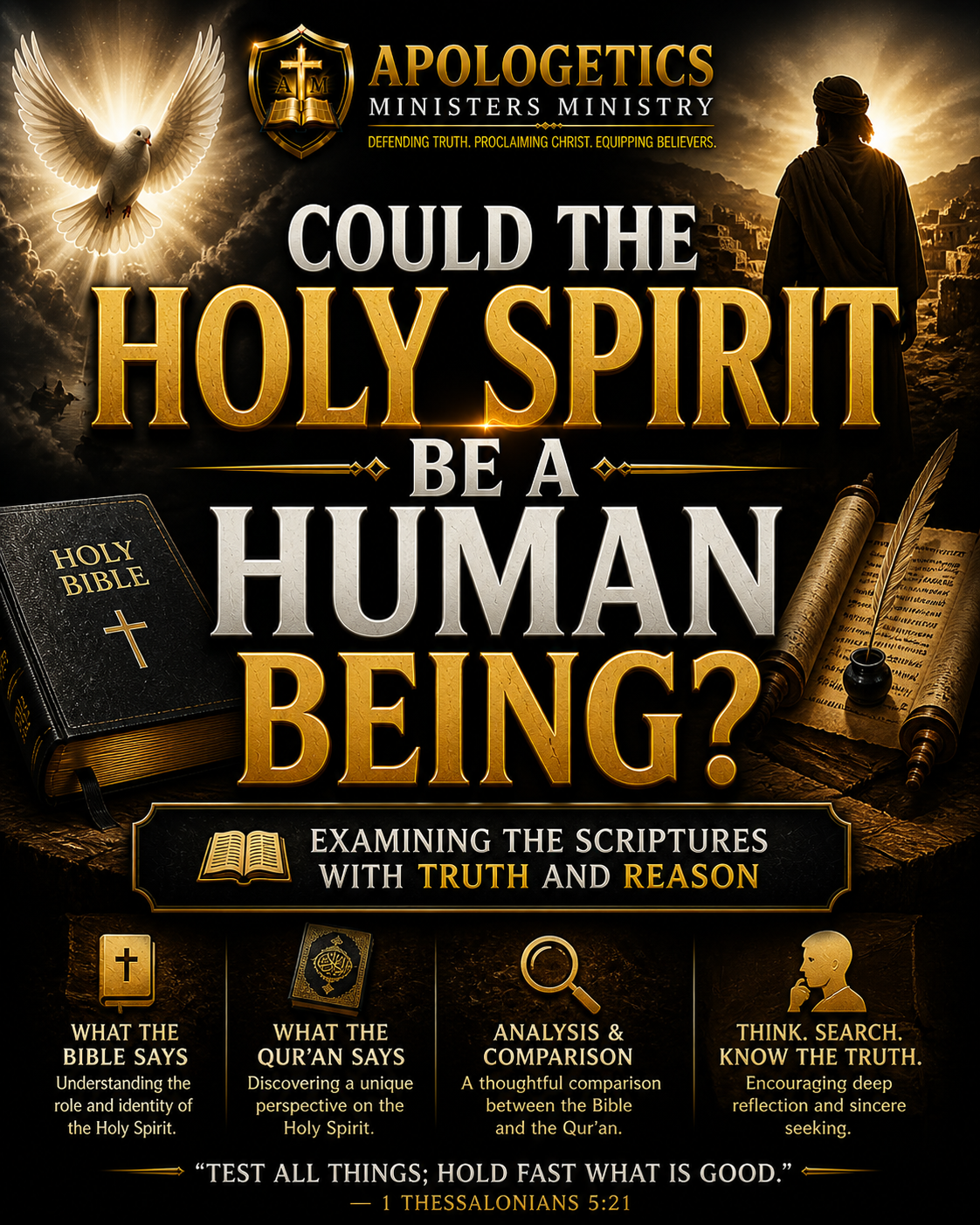

Could the Holy Spirit Be a Human Being?
Introduction
Across religious discussions—especially in Christian–Muslim dialogue—one recurring claim is that the “Holy Spirit” spoken of by Jesus might refer not to a divine Spirit, but to a future human prophet. In some arguments, this claim is extended further to suggest that Muhammad is the fulfillment of that promise.
At first glance, this idea may appear to offer a bridge between two faith traditions. However, a careful and honest examination of both the Bible and the Qur’an reveals deep theological, logical, and textual problems with redefining the Holy Spirit as a human being. This article explores that question in detail: Can the Holy Spirit be a human? And more specifically, does it make sense—biblically or Islamically—to identify the Holy Spirit with Muhammad?
We will approach this discussion respectfully but critically, examining Scripture, theology, and reason.
1. What Is the Holy Spirit According to the Bible?
To understand whether the Holy Spirit could be human, we must first ask: How does the Bible describe the Holy Spirit?
From Genesis to Revelation, the Holy Spirit is consistently presented not as a man, prophet, or created being—but as God’s Spirit, possessing divine attributes.
A. The Holy Spirit Is Non-Human
The Bible clearly distinguishes the Holy Spirit from human beings.
John 4:24 — “God is Spirit, and those who worship Him must worship in spirit and truth.”
Luke 24:39 — “A spirit does not have flesh and bones.”
The Holy Spirit is not described as having a physical body, genealogy, or earthly life. He is not born, does not eat, does not grow, and does not die. These are essential characteristics of human beings—but none apply to the Holy Spirit.
By contrast, Muhammad was undeniably human—born in Mecca, lived a physical life, experienced hunger, fatigue, and death. Therefore, identifying a clearly non-human Spirit with a historical human figure creates an immediate contradiction.
B. The Holy Spirit Is Omnipresent
One of the defining attributes of the Holy Spirit is omnipresence—being present everywhere at once.
Psalm 139:7–8 — “Where can I go from Your Spirit? Where can I flee from Your presence?”
The Spirit is not limited by time or space. He is present with believers across the entire world simultaneously.
Now consider the implication:
If the Holy Spirit were a human being—such as Muhammad—then he would be limited to one place at a time. No human being, no matter how great, can be physically present in multiple locations simultaneously.
This is not just a theological issue—it is a logical impossibility.
C. The Holy Spirit Dwells Within Believers
Another central biblical teaching is that the Holy Spirit lives inside believers.
1 Corinthians 6:19 — “Your body is the temple of the Holy Spirit who is in you.”
John 14:17 — “He dwells with you and will be in you.”
This indwelling is not symbolic—it is described as a real, spiritual presence within millions of people at once.
Now ask a simple question:
How can a human being dwell inside millions of believers simultaneously?
If the Holy Spirit were Muhammad, then:
He would have to be physically inside believers
He would have to exist in multiple bodies at once
He would have to transcend physical limitations
At that point, he would no longer be human. The argument collapses under its own weight.
2. The Logical Problem: Can a Human Be the Holy Spirit?
Beyond theology, there is a serious logical issue with redefining the Holy Spirit as a human being.
A. Human Limitations vs. Divine Attributes
Humans are:
Limited in space (can only be in one place)
Limited in knowledge
Limited in lifespan
Dependent on physical existence
But the Holy Spirit is described as:
Everywhere present
All-knowing (1 Corinthians 2:10)
Eternal (Hebrews 9:14)
Spirit, not flesh
To claim that a human is the Holy Spirit is to attribute divine qualities to a human—something both Christianity and Islam reject.
B. Presence in Millions of Believers
Christianity teaches that every true believer receives the Holy Spirit.
That means:
Millions of people across continents
At the same time
All indwelt by the same Spirit
No human can achieve this.
Even the greatest prophets—Moses, Elijah, Jesus (in His human nature), or Muhammad—were physically present in one location at a time.
To redefine a human as omnipresent is no longer to speak of a human—it is to speak of something divine.
C. Internal vs. External Guidance
A prophet gives external guidance—through speech, teaching, and example.
The Holy Spirit provides internal transformation—guiding thoughts, convicting hearts, and renewing the inner life.
These are fundamentally different roles.
A human prophet speaks to you.
The Holy Spirit works within you.
Confusing the two is not just a theological error—it is a category mistake.
3. The Islamic Perspective: Who Is the Holy Spirit?
Now let us turn to Islam. Even if one rejects the biblical view, does Islam support the idea that Muhammad is the Holy Spirit?
The answer is clearly no.
A. The Holy Spirit in the Qur’an
The Qur’an mentions the “Holy Spirit” (Ruh al-Qudus) in several places:
Qur’an 2:87 — Jesus was strengthened with the Holy Spirit
Qur’an 16:102 — The Holy Spirit brought down revelation
Islamic scholars overwhelmingly identify the Holy Spirit as Jibreel (Gabriel).
B. Muhammad and Jibreel Are Distinct
In Islamic tradition:
Jibreel is the angel who delivers revelation
Muhammad is the human recipient of revelation
They are clearly not the same being.
For example:
Jibreel appears to Muhammad
Jibreel speaks to Muhammad
Jibreel brings the Qur’an to Muhammad
If Muhammad were the Holy Spirit, this relationship would make no sense.
C. Classical Islamic Interpretation
Major Islamic scholars such as:
Ibn Kathir
Al-Tabari
Al-Qurtubi
All identify the Holy Spirit as Gabriel—not Muhammad.
This means that even within Islamic theology:
Muhammad ≠ Holy Spirit
So the claim fails not only biblically and logically, but also within Islam itself.
4. The Misinterpretation of Jesus’ Promise
Some arguments linking Muhammad to the Holy Spirit rely on passages where Jesus promises the coming of the “Comforter” or “Helper” (John 14–16).
However, a closer reading shows that this figure:
Will dwell within believers
Will be with them forever
Will be sent after Jesus’ departure
Will remind them of Jesus’ teachings
These descriptions align with the Holy Spirit—not a future human prophet.
A human prophet:
Cannot live forever with believers
Cannot dwell within them
Cannot be universally present
Thus, the interpretation does not fit the text.
5. Theological Consequences of Redefining the Holy Spirit
If we redefine the Holy Spirit as a human being, several major problems arise:
A. Collapse of Biblical Theology
The Trinity becomes meaningless
God’s indwelling presence disappears
Salvation becomes external rather than internal
B. Elevation of a Human to Divine Status
Ironically, claiming a human is the Holy Spirit gives that human:
Omnipresence
Divine authority
Spiritual indwelling power
This contradicts strict monotheism.
C. Confusion Between Roles
Prophet → messenger
Spirit → divine presence
Blurring these roles leads to doctrinal confusion.
6. A Clear Conclusion
After examining the evidence, the conclusion is unavoidable:
The Holy Spirit cannot be a human being.
Because:
The Bible describes the Spirit as non-human, omnipresent, and indwelling
Logic shows that no human can possess these attributes
The Qur’an identifies the Holy Spirit as Jibreel, not Muhammad
Therefore:
Muhammad is not the Holy Spirit—neither biblically, logically, nor Islamically.
Final Reflection
This discussion is not about disrespect, but about clarity and truth. Muhammad is honored in Islam as a prophet, just as Christians honor biblical prophets. However, elevating any human to the status of the Holy Spirit introduces contradictions that cannot be sustained.
The Holy Spirit, as revealed in Scripture, is not a man who came and went—but the living, active presence of God, dwelling within believers, guiding, transforming, and sustaining them.
To understand Him correctly is not only a matter of theology—it is a matter of knowing how God relates to humanity.