



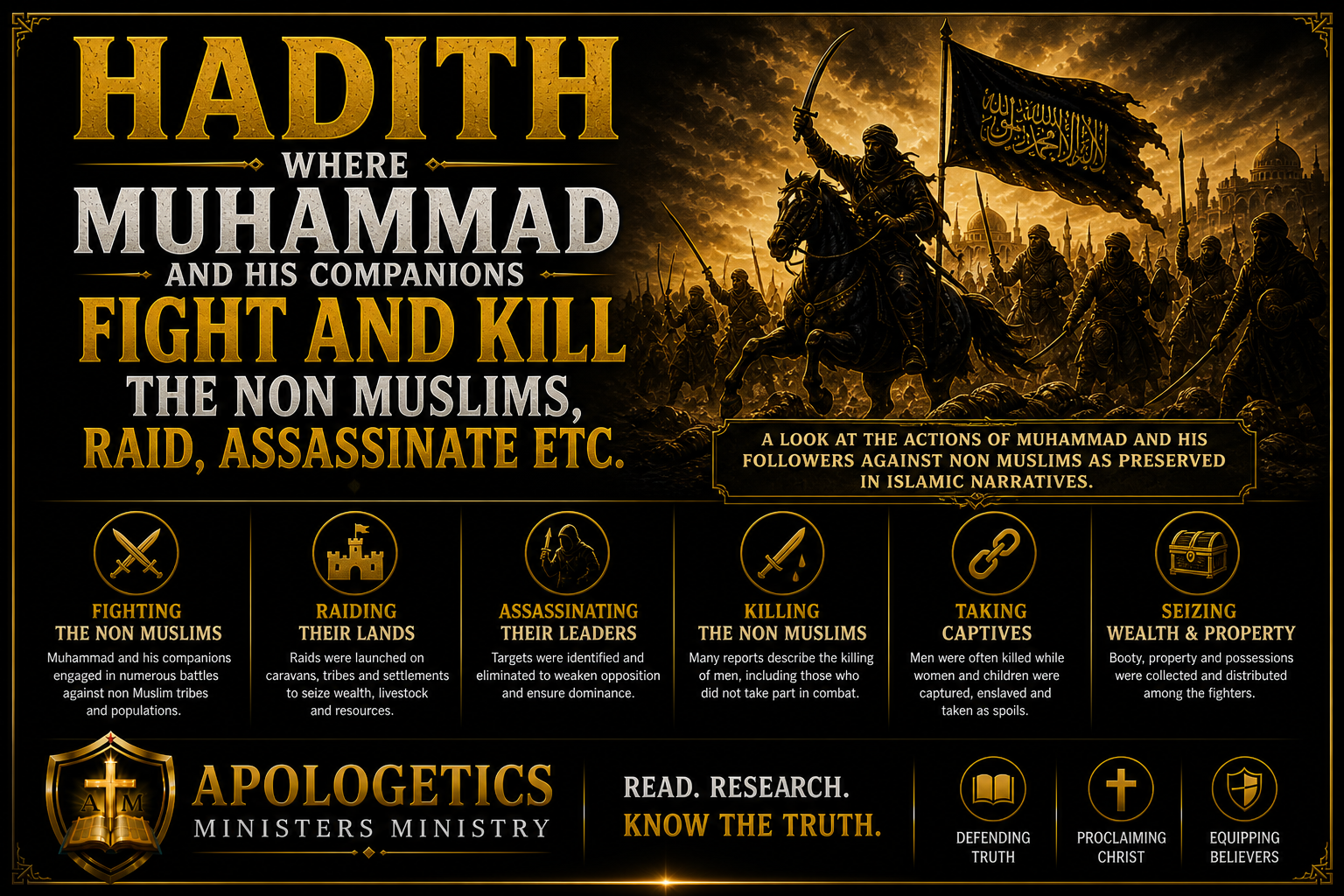

1. Intercepting Caravans (Ghazawat and Saraya)
These expeditions were specifically aimed at the trade routes between Mecca and Syria.
| Event | Ibn Ishaq / Guillaume (Page) | Description |
| Expedition of Hamza | p. 283 | The first raid sent to the coast to intercept a caravan led by Abu Jahl. No fighting occurred. |
| Expedition of Buwat | p. 285 | Muhammad led men to intercept a Quraish caravan led by Umayya bin Khalaf. |
| Expedition of Zul Al-Ushairah | p. 285 | Muhammad intercepted a large caravan led by Abu Sufyan; this same caravan would later lead to the Battle of Badr. |
| Nakhla Raid | pp. 286-289 | Abdullah bin Jahsh was sent to Nakhla. They attacked a caravan, killed one man, and took two prisoners and the goods. This happened in a Sacred Month. |
| Battle of Badr | pp. 289-300 | Explicitly stated: Muhammad went out to intercept Abu Sufyan’s caravan to seize its property. This escalated into the first major war. |
| Raid on al-Qarada | p. 364 | Zayd bin Harithah was sent to intercept a caravan carrying a large amount of silver belonging to the Quraish. The Muslims seized the silver. |
2. Seizing Property and Wealth
In the Sira, wealth taken from defeated or expelled groups was distributed among the Muslims.
| Event | Ibn Ishaq / Guillaume (Page) | Description |
| Expulsion of Banu Nadir | pp. 437-438 | After the siege of this Jewish tribe, Muhammad confiscated all their property, including their lands and palm trees. |
| Banu Qaynuqa | p. 363 | Following their surrender, the tribe was expelled and their tools and property were taken as spoils. |
| Banu Qurayza | pp. 464-466 | After the execution of the men, the property, lands, women, and children were divided among the Muslims. |
| Conquest of Khaybar | pp. 510-515 | Large amounts of land and treasure (including the treasure of Kinana) were seized. |
3. Targeted Assassinations (Ordered by Muhammad)
The Sira details specific individuals who were killed by small groups on the Prophet’s orders.
| Target | Ibn Ishaq / Guillaume (Page) | Reason Cited in Sira |
| Asma bint Marwan | pp. 675-676 | A poetess who wrote verses mocking Muhammad and inciting her tribe against him. |
| Abu Afak | p. 675 | An elderly man who wrote satirical poetry against the Prophet. |
| Ka’b bin al-Ashraf | pp. 364-368 | A Jewish leader who went to Mecca to incite the Quraish to war after Badr. |
| Sallam ibn Abu’l-Huqayq | pp. 482-483 | A leader of the Banu Nadir who helped organize the “Confederates” army. |
| Ibn Khatal | p. 550 | One of the few individuals ordered to be killed during the Conquest of Mecca, even if found at the Kaaba. |
| Yusayr bin Rizam | pp. 665-666 | A leader at Khaybar suspected of trying to rally tribes for a new attack. |
1. Intercepting Caravans and Seizing Property
Tabari categorizes these as the early Saraya (raids) intended to pressure the Quraish economically.
| Event | Tabari Volume | Page (SUNY) | Description |
| Raid of Nakhla | Vol. 7 | pp. 18-23 | The first time blood was shed and property seized. Tabari details the capture of the caravan and the taking of the Khums (one-fifth) for the Prophet. |
| The Great Raid of Badr | Vol. 7 | pp. 28-32 | Tabari records Muhammad saying: “This is the caravan of Quraish containing their property. Go out to it; perhaps Allah will give it to you as prey.” |
| Banu Nadir (Property) | Vol. 7 | pp. 156-161 | The seizure of their lands, palm trees, and armors. Tabari notes this property was “purely for the Prophet” as no horses or camels were spurred in a major battle. |
| Khaybar (Treasures) | Vol. 8 | pp. 122-124 | The discovery of the hidden treasure of the Banu Nadir (the “Kinana treasure”). Tabari describes the interrogation and subsequent execution of Kinana to reveal the wealth. |
2. Ordered Assassinations
Tabari provides the narrative of why these individuals were targeted, usually citing their poetry or their efforts to rally tribes against Medina.
| Target | Tabari Volume | Page (SUNY) | Context |
| Ka’b bin al-Ashraf | Vol. 7 | pp. 94-98 | Detailed account of the ruse used to lure him out of his fortress at night to be killed. |
| Abu Rafi’ | Vol. 7 | pp. 99-100 | The mission to Khaybar to kill the merchant leader who was financing the “Parties” (Al-Ahzab). |
3. Mass Executions and Captives
| Event | Tabari Volume | Page (SUNY) | Description |
| Banu Qurayza | Vol. 8 | pp. 34-35 | The account of the trenches dug in the marketplace of Medina and the beheading of 600 to 900 men of the tribe. |
| Conquest of Mecca | Vol. 8 | pp. 178-181 | The “List of Proscribed Persons” who were to be killed even if found under the Kaaba’s curtains. |
THE FINAL QUESTION OF TRUTH, CHARACTER, AND GOD
Every serious search for truth must eventually come to an honest conclusion. Evidence must be weighed, moral claims examined, and spiritual implications faced without evasion. This book has not attempted to compare Christianity and Islam on the basis of culture, ethnicity, or modern politics, but on the only grounds that ultimately matter: the character, teachings, and moral example of their founders as revealed in their own authoritative sources.
Throughout these chapters, we have examined Jesus Christ and Muhammad side by side—how they claimed revelation, how they treated women, how they addressed sinners, how they used power, how they responded to enemies, and how they defined holiness. The contrast that emerges is not accidental, minor, or the result of misinterpretation. It is consistent, foundational, and irreconcilable.
Jesus Christ reveals a kingdom not built by force but by truth, not defended by the sword but established through sacrifice. He calls sinners not to die for refusing Him, but to live through repentance and grace. He does not coerce faith; He invites it. He does not kill His enemies; He prays for them. He does not spread His message by bloodshed; He seals it with His own blood. In the life of Jesus, holiness and love are never separated. Righteousness is not imposed externally but formed inwardly through transformation of the heart.
By contrast, the Islamic sources examined in this book present a system in which religious authority is enforced through power, unbelief is criminalized, and submission is secured through coercion. Violence is not merely contextual but theological. The sword is not an anomaly but a tool. Repentance is tied to survival, and faith is often reduced to outward conformity rather than inward regeneration. These conclusions are not drawn from hostile sources, but from the Qur’an, Hadith, Tafsīr, and Sīrah themselves.
This leads to an unavoidable theological question: Can both visions come from the same God? A God who commands the killing of sinners and a God who dies for sinners cannot be morally identical. A revelation that advances by fear and force cannot be harmonized with one that advances by love and self-giving sacrifice. To claim that Jesus and Muhammad represent the same moral revelation is to empty words like justice, mercy, and holiness of all meaning.
This book has not argued that Muslims are morally inferior or incapable of goodness. Human beings are made in the image of God, and conscience testifies to moral truth even when theology is flawed. The issue is not the sincerity of followers, but the reliability of the founder and the nature of the revelation he represents. Sincerity does not make error true, nor does devotion transform violence into holiness.
Christian faith stands or falls on Jesus Christ. If Jesus is who He claimed to be—the revelation of the Father, the embodiment of divine love, the Savior who conquers sin through the cross—then no later revelation that contradicts His character can be from God. Scripture itself warns that even powerful claims, signs, or new messages must be rejected if they oppose what God has already revealed in truth and righteousness.
The gospel does not fear comparison. It invites examination. It does not demand submission at the point of a sword, but repentance at the foot of the cross. It does not threaten the sinner with death for disbelief, but offers forgiveness, adoption, and new life through Christ. This is not weakness. It is divine strength expressed through love.
The question this book leaves with the reader is not merely academic. It is personal and eternal. If God is truly holy and loving, His revelation will reflect that holiness and love consistently. If Jesus reveals a God who seeks the lost, forgives enemies, and redeems sinners through self-sacrifice, then He alone is worthy of trust, worship, and imitation.Truth does not need violence to defend it. Love does not need coercion to triumph. Light does not fear scrutiny. The final question remains, and it cannot be avoided:
When the evidence is examined honestly, when the moral visions are compared carefully, and when the character of God is weighed faithfully—who truly reveals the heart of God: Jesus Christ or Muhammad?
The answer carries eternal consequences.