



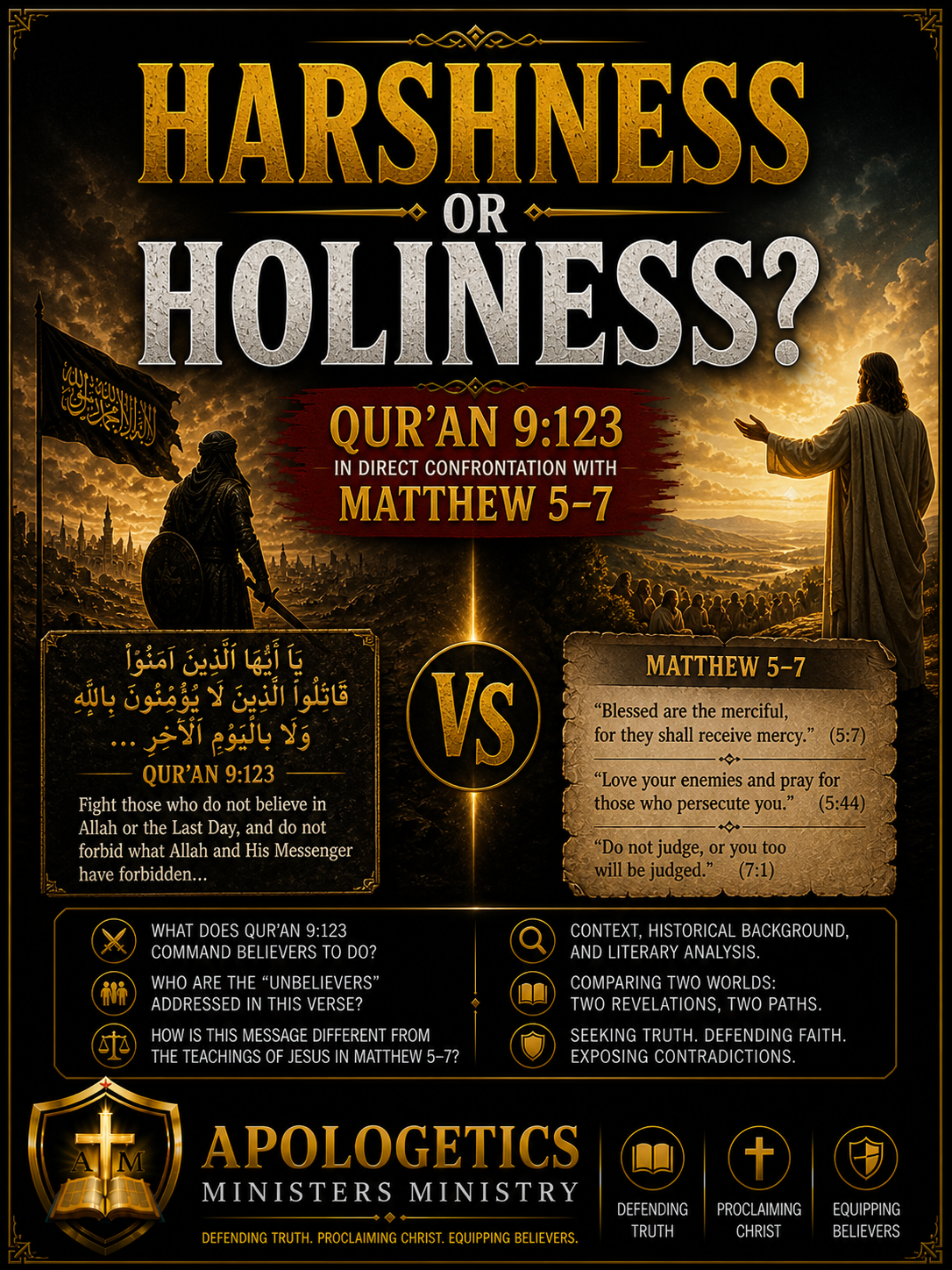

HARSHNESS OR HOLINESS?
QUR’AN 9:123 IN DIRECT CONFRONTATION WITH MATTHEW 5–7
Introduction: Two Voices Claiming Moral Authority
Every claim to divine revelation must ultimately be tested by moral coherence. Scripture does not merely inform; it forms character. It teaches believers how to think, how to treat others, and what kind of people they are meant to become.
In this chapter, we place Qur’an 9:123 side by side with Matthew chapters 5–7, known as the Sermon on the Mount, the clearest and most comprehensive ethical teaching of Jesus Christ.
This comparison is not superficial. These texts represent two moral universes—two visions of holiness, two paths for human conduct, and ultimately two radically different understandings of God.
I. Qur’an 9:123 — A Command to Fight and Be Harsh
Arabic
يَٰٓأَيُّهَا ٱلَّذِينَ ءَامَنُوا۟ قَٰتِلُوا۟ ٱلَّذِينَ يَلُونَكُم مِّنَ ٱلْكُفَّارِ وَلْيَجِدُوا۟ فِيكُمْ غِلْظَةً ۚ وَٱعْلَمُوٓا۟ أَنَّ ٱللَّهَ مَعَ ٱلْمُتَّقِينَ
Sahih Intl
O you who have believed, fight those adjacent to you of the disbelievers and let them find in you harshness. And know that Allah is with the righteous.
TAFSIR IBN KATHIR.
The Order for Jihad against the Disbelievers, the Closest, then the Farthest Areas
Allah commands the believers to fight the disbelievers, the closest in area to the Islamic state, then the farthest. This is why the Messenger of Allah started fighting the idolators in the Arabian Peninsula. When he finished with them and Allah gave him control over Makkah, Al-Madinah, At-Ta’if, Yemen, Yamamah, Hajr, Khaybar, Hadramawt and other Arab provinces, and the various Arab tribes entered Islam in large crowds, he then started fighting the People of the Scriptures. He began preparations to fight the Romans who were the closest in area to the Arabian Peninsula, and as such, had the most right to be called to Islam, especially since they were from the People of the Scriptures. The Prophet marched until he reached Tabuk and went back because of the extreme hardship, little rain and little supplies. This battle occurred on the ninth year after his Hijrah. In the tenth year, the Messenger of Allah was busy with the Farewell Hajj. The Messenger died eighty-one days after he returned from that Hajj, Allah chose him for what He had prepared for him in Paradise. After his death, his executor, friend, and Khalifah, Abu Bakr As-Siddiq, may Allah be pleased with him, became the leader. At that time, the religion came under attack and would have been defeated, if it had not been for the fact that Allah gave the religion firmness through Abu Bakr, who established its basis and made its foundations firm. He brought those who strayed from the religion back to it, and made those who reverted from Islam return. He took the Zakah from the evil people who did not want to pay it, and explained the truth to those who were unaware of it. On behalf of the Prophet, Abu Bakr delivered what he was entrusted with. Then, he started preparing the Islamic armies to fight the Roman cross worshippers, and the Persian fire worshippers. By the blessing of his mission, Allah opened the lands for him and brought down Caesar and Kisra and those who obeyed them among the servants. Abu Bakr spent their treasures in the cause of Allah, just as the Messenger of Allah had foretold would happen. This mission continued after Abu Bakr at the hands of he whom Abu Bakr chose to be his successor, Al-Faruq, the Martyr of the Mihrab, Abu Hafs, `Umar bin Al-Khattab, may Allah be pleased with him. With `Umar, Allah humiliated the disbelievers, suppressed the tyrants and hypocrites, and opened the eastern and western parts of the world. The treasures of various countries were brought to `Umar from near and far provinces, and he divided them according to the legitimate and accepted method. `Umar then died as a martyr after he lived a praise worthy life. Then, the Companions among the Muhajirin and Ansar agreed to chose after `Umar, `Uthman bin `Affan, Leader of the faithful and Martyr of the House, may Allah be pleased with him. During `Uthman’s reign, Islam wore its widest garment and Allah’s unequivocal proof was established in various parts of the world over the necks of the servants. Islam appeared in the eastern and western parts of the world and Allah’s Word was elevated and His religion apparent. The pure religion reached its deepest aims against Allah’s enemies, and whenever Muslims overcame an Ummah, they moved to the next one, and then the next one, crushing the tyranical evil doers. They did this in reverence to Allah’s statement,
(O you who believe! Fight those of the disbelievers who are close to you,) Allah said next,
(and let them find harshness in you), meaning, let the disbelievers find harshness in you against them in battle. The complete believer is he who is kind to his believing brother, and harsh with his disbelieving enemy. Allah said in other Ayah,
(Allah will bring a people whom He will love and they will love Him; humble towards the believers, stern towards the disbelievers…)5:54,
(Muhammad is the Messenger of Allah. And those who are with him are severe against the disbelievers, and merciful among themselves.)48:29, and,
(O Prophet! Strive hard against the disbelievers and the hypocrites, and be harsh against them.)9:73 Allah said,
(And know that Allah is with those who have Taqwa), meaning, fight the disbelievers and trust in Allah knowing that Allah is with you if you fear and obey Him. This was the case in the first three blessed generations of Islam, the best members of this Ummah. Since they were firm on the religion and reached an unsurpassed level of obedience to Allah, they consistently prevailed over their enemies. During that era, victories were abundant, and enemies were ever more in a state of utter loss and degradation. However, after the turmoil began, desires and divisions became prevalent between various Muslim kings, the enemies were eager to attack the outposts of Islam and marched into its territory without much opposition. Then, the Muslim kings were too busy with their enmity for each other. The disbelievers then marched to the capital cities of the Islamic states, after gaining control over many of its areas, in addition to entire Islamic lands. Verily, ownership of all affairs is with Allah in the beginning and in the end. Whenever a just Muslim king stood up and obeyed Allah’s orders, all the while trusting in Allah, Allah helped him regain control over some Muslim lands and took back from the enemy what was compatible to his obedience and support to Allah. We ask Allah to help the Muslims gain control over the forelocks of His disbeliever enemies and to raise high the word of Muslims over all lands. Verily, Allah is Most Generous, Most Giving.
This verse issues a direct military command. The instruction is not symbolic, spiritual, or conditional. It contains three decisive elements:
1. Fight — physical warfare (قاتلوا)
2. Those nearest to you of the disbelievers — geographical and religious targeting
3. Let them find harshness in you — severity as a moral requirement
Harshness here is not regrettable collateral damage. It is divinely commanded behavior.
The verse does not say:
“If they attack you”
“If they oppress you”
“If peaceful means fail”
Instead, disbelief itself becomes the justification.
II. Matthew 5–7 — The Ethical Heart of Jesus’ Teaching
Matthew 5–7 records Jesus speaking publicly, authoritatively, and intentionally about the nature of righteousness.
Jesus begins:
“Blessed are the meek… Blessed are the merciful… Blessed are the peacemakers.” (Matthew 5:5–9)
From the outset, Jesus redefines strength. Power is not dominance; holiness is not harshness.
The Sermon on the Mount is not advice for weakness—it is a manifesto for the Kingdom of God.
III. Treatment of Enemies: Violence vs. Love
Qur’an 9:123
Commands fighting
Mandates harshness
Identifies unbelievers as targets
Jesus (Matthew 5:44) “Love your enemies and pray for those who persecute you.”
This is not rhetorical exaggeration. Jesus explicitly rejects:
Retaliation, Violence, Coercion.
He continues:
“If anyone slaps you on the right cheek, turn to them the other also.” (Matthew 5:39)
Here lies the irreconcilable divide.
Qur’an 9:123 commands believers to cultivate severity.
Jesus commands believers to cultivate radical love, even when wronged.
No theological maneuver can harmonize these teachings.
Harshness vs. Mercy as Divine Attributes
Qur’an 9:123 explicitly instructs believers to let others experience harshness through them.
By contrast, Jesus teaches: Be merciful, just as your Father is merciful.” (Luke 6:36)
In Matthew 5:7: “Blessed are the merciful, for they shall obtain mercy.”
In biblical theology:
God’s holiness produces mercy
God’s righteousness restrains violence
God’s truth persuades rather than coerces
A command to be harsh toward people because of belief status contradicts the moral nature of God revealed by Christ.
Expansion by Force vs. Witness by Example
Qur’an 9:123 assumes and encourages expansion by confrontation. Begin with those nearest. Advance outward.
Jesus explicitly rejects this model:
“My kingdom is not of this world. If it were, my servants would fight.” (John 18:36)
In Matthew 5–7, Jesus never instructs His followers to:
Seize territory
Enforce belief
Punish unbelief
Instead, He commands them to:
Be salt and light (Matthew 5:13–16)
Influence society through visible righteousness
Suffer persecution rather than inflict it (Matthew 5:10–12)
The kingdom Jesus proclaims grows by transformation, not intimidation.
Law, Violence, and the Heart
In Matthew 5:21–22, Jesus intensifies the moral law:
> “You have heard that it was said, ‘You shall not murder’… but I tell you that anyone who is angry with a brother will be subject to judgment.”
Jesus moves morality inward, condemning even the heart that delights in harm.
Qur’an 9:123 moves morality outward, sanctifying violence and harshness as obedience.
One reforms the heart.
The other mobilizes the sword.
Hypocrisy, Power, and Religious Authority
Jesus repeatedly warns against religious systems that use power to dominate:
“You know that the rulers of the Gentiles lord it over them… Not so with you.” (Matthew 20:25–26)
In Matthew 7:15–20, Jesus warns:
“Beware of false prophets… by their fruit you will recognize them.”
A teaching that produces:
Fear
Coercion
Violence against dissenters
…fails Jesus’ test of fruit.
Qur’an 9:123 has historically borne fruit in:
Military expansion
Subjugation of minorities
Religious coercion
This is not accidental. It flows directly from the text.
Suffering vs. Inflicting Suffering
Jesus concludes the Sermon on the Mount by calling for obedience rooted in trust in God, not force:
“Blessed are those who are persecuted for righteousness’ sake.” (Matthew 5:10)
Christian holiness assumes the willingness to suffer rather than cause suffering.
Qur’an 9:123 assumes the willingness to cause suffering to achieve submission.
These are not two paths to the same God. They are opposing moral trajectories.
The Cross vs. the Sword
The Sermon on the Mount only makes sense in light of the Cross.
Jesus does not merely teach love for enemies—He demonstrates it:
“Father, forgive them.” (Luke 23:34)
He conquers not by killing, but by dying.
Qur’an 9:123 points believers toward victory through confrontation.
Jesus points believers toward victory through self-giving love.
Conclusion: An Unavoidable Moral Judgment
When Qur’an 9:123 is placed directly against Matthew 5–7, the contrast is devastating.
Harshness vs. Mercy
Force vs. Love
Conquest vs. Cross
Fear vs. Transformation
A God who commands believers to be harsh toward unbelievers cannot be the same God who commands love for enemies.
This is not cultural misunderstanding. This is not historical accident. This is a fundamental moral contradiction.
Christians are therefore right—morally, theologically, and biblically—to reject Qur’an 9:123 as incompatible with the character of the holy God revealed in Jesus Christ.
The Sermon on the Mount stands as a permanent rebuke to every theology that seeks to advance “truth” through the sword.
Truth does not need harshness.
Holiness does not produce cruelty.
And God does not require violence to be glorified.