



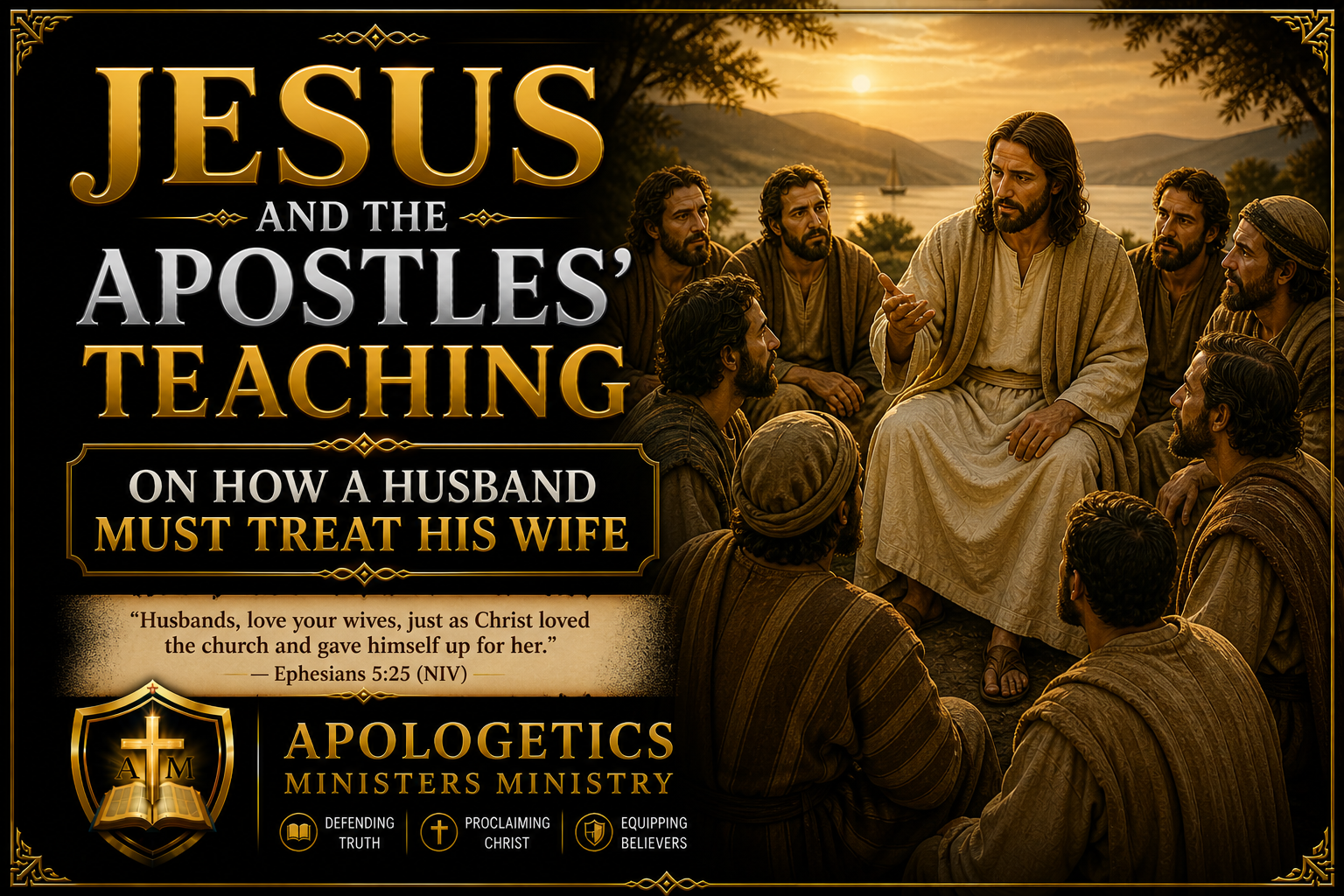

JESUS AND THE APOSTLES’ TEACHING
ON HOW A HUSBAND MUST TREAT HIS WIFE
Christian teaching on marriage is not rooted in power, culture, or male dominance. It is rooted in the nature of God and revealed most clearly in the life and words of Jesus Christ. From Genesis to the teachings of the apostles, Scripture presents marriage as a sacred covenant in which love, holiness, sacrifice, and mutual dignity are central. The way a husband treats his wife is not a private matter in Christianity; it is a spiritual matter that reveals whether a man truly understands God.
Jesus did not approach marriage as a social contract designed for convenience or control. He treated it as a divine union that reflects God’s faithfulness. When questioned about divorce, Jesus did not debate legal loopholes. Instead, He pointed His listeners back to God’s original design at creation. In Matthew 19:4–6, Jesus declared that God created male and female and joined them together so that the two become one flesh. He concluded with a command that reshaped marriage forever: “What therefore God has joined together, let not man separate.” By grounding marriage in creation, Jesus established that it is not owned by culture, tradition, or personal desire, but by God Himself.
This teaching immediately elevates how a husband must treat his wife. If marriage is God’s work, then a wife is not property, subordinate flesh, or an object of control. She is a covenant partner joined by God. To harm her is not merely to harm another person; it is to violate something God has joined together. Jesus’ words leave no room for domination or abuse. Authority in marriage is not the authority to harm, but the responsibility to protect.
Jesus’ own life reinforces this teaching. Although He never married, His interactions with women were radically counter-cultural. He spoke with women publicly, something many religious leaders avoided (John 4:7–27). He defended women from public shame and condemnation, as seen in His protection of the woman caught in adultery (John 8:1–11). He welcomed women as disciples and witnesses, even appearing first to women after His resurrection (Matthew 28:1–10). At no point did Jesus use power to control women. His authority was expressed through compassion, truth, and self-giving love.
Jesus also redefined leadership itself. When His disciples argued about greatness, He rebuked their understanding of authority and said, “You know that the rulers of the Gentiles lord it over them… It shall not be so among you” (Matthew 20:25–26). Leadership in God’s kingdom is not domination but service. This principle applies directly to marriage. A husband does not lead by force, fear, or coercion, but by example, sacrifice, and love.
The apostles took Jesus’ teaching and applied it directly to married life. No passage does this more clearly than Ephesians 5:22–33. This text is often misunderstood because it begins with a call for wives to submit, but the controlling command of the passage is actually given to husbands. Paul commands husbands to love their wives “as Christ loved the church and gave Himself up for her” (Ephesians 5:25). This is not symbolic language. It is a demand that a husband’s love be cruciform—shaped by the cross.
Christ’s love for the church is sacrificial, not controlling. He does not strike the church; He dies for her. He does not dominate her; He cleanses her. Paul says Christ gave Himself up “that He might sanctify her, having cleansed her by the washing of water with the word” (Ephesians 5:26). This means a husband’s role is not to discipline through force, but to nurture spiritually. He is called to create an environment of safety, holiness, and growth.
Paul intensifies this command by saying, “He who loves his wife loves himself” (Ephesians 5:28). Because husband and wife are one flesh, harm to a wife is self-harm. Abuse, neglect, and harshness are therefore not merely sins against another person, but against the unity God has created. Paul leaves no room for cruelty. He concludes by commanding that the husband love his wife as himself, and that the wife be treated with respect (Ephesians 5:33).
The apostle Peter reinforces this teaching with remarkable clarity. In 1 Peter 3:7, he commands husbands to live with their wives in an understanding way, showing honor to the woman as the weaker vessel and as heirs together of the grace of life. The phrase “weaker vessel” does not imply inferiority, but vulnerability. Peter calls husbands to awareness of physical and social realities and commands them to respond with honor, not exploitation. He adds a severe warning: if a husband fails to treat his wife with honor, his prayers will be hindered. This means that mistreatment of a wife directly damages a man’s relationship with God.
Paul echoes this principle in Colossians 3:19 with blunt simplicity: “Husbands, love your wives, and do not be harsh with them.” The command is not complex. There is no qualification, no allowance for anger, frustration, or cultural excuses. Harshness toward one’s wife is incompatible with Christian faith. Any system that permits physical violence, humiliation, or intimidation within marriage stands in direct contradiction to apostolic teaching.
The New Testament also links marital love with spiritual maturity. In 1 Timothy 3:4–5, Paul teaches that a man’s ability to lead in the church is directly connected to how he manages his household. A man who cannot love and care for his wife and family is disqualified from spiritual leadership. Christianity does not separate theology from domestic behavior. The home is the proving ground of faith.
Underlying all apostolic teaching on marriage is a theology of the body. Paul teaches that the body is a temple of the Holy Spirit (1 Corinthians 6:19–20). This applies equally to husbands and wives. A wife’s body is not subject to her husband’s violence or control. Sexual relations in marriage are governed by mutuality, not dominance. Paul teaches that the husband does not have authority over his own body alone, but the wife does also, and vice versa (1 Corinthians 7:3–4). This mutual authority rules out coercion and affirms equality in dignity.
Christian marriage therefore rests on covenant, not contract. A covenant is not temporary or conditional. It mirrors God’s faithful love toward His people. Throughout Scripture, God condemns those who deal treacherously with their wives (Malachi 2:14–16). God declares that He hates violence and injustice within marriage. This prophetic voice carries directly into the New Testament ethic.
Jesus’ own relationship with the church is the ultimate model. The church is often weak, sinful, and unfaithful, yet Christ responds not with violence or abandonment, but with patience, intercession, and self-giving love. He bears wounds for her healing. He absorbs wrong rather than inflicting it. A husband who claims Christ but harms his wife denies the very gospel he professes.
This teaching stands in sharp contrast to moral systems that permit male authority to be enforced through fear or physical force. Christianity does not sanctify power; it crucifies it. Authority is not a license to command, but a call to die to self. The cross is the pattern for all Christian leadership, including leadership in the home.
In Christian theology, marriage is also eschatological—it points forward to something greater. Paul says marriage is a mystery that refers to Christ and the church (Ephesians 5:32). This means how a husband treats his wife is a living testimony to the world about who Christ is. A violent, harsh, or controlling husband preaches a false gospel. A loving, faithful, sacrificial husband bears witness to the true Christ.
The apostles never instruct wives to endure abuse as obedience to God. Instead, they place the weight of responsibility on husbands. Love is commanded. Harshness is forbidden. Honor is required. Protection is expected. A man who violates these commands stands condemned by Scripture, regardless of his religious claims.
Christianity does not claim that marriage is easy. It demands repentance, humility, and daily self-denial. But it insists that holiness is possible through grace. Jesus does not lower the standard to accommodate sin; He empowers obedience through the Holy Spirit. This is why Christian marriage, at its best, reflects healing, safety, and dignity.
In the end, the Christian vision of marriage is not about control but about Christ. A husband is not called to rule over his wife, but to lay down his life for her. He is not permitted to strike, threaten, or dominate. He is commanded to love, honor, and serve. This is not weakness; it is the strength of the cross.Where Christ reigns, violence has no place in marriage. Where the Spirit dwells, love governs authority. And where the gospel is truly believed, a wife is not feared or controlled, but cherished as a fellow heir of the grace of life.