



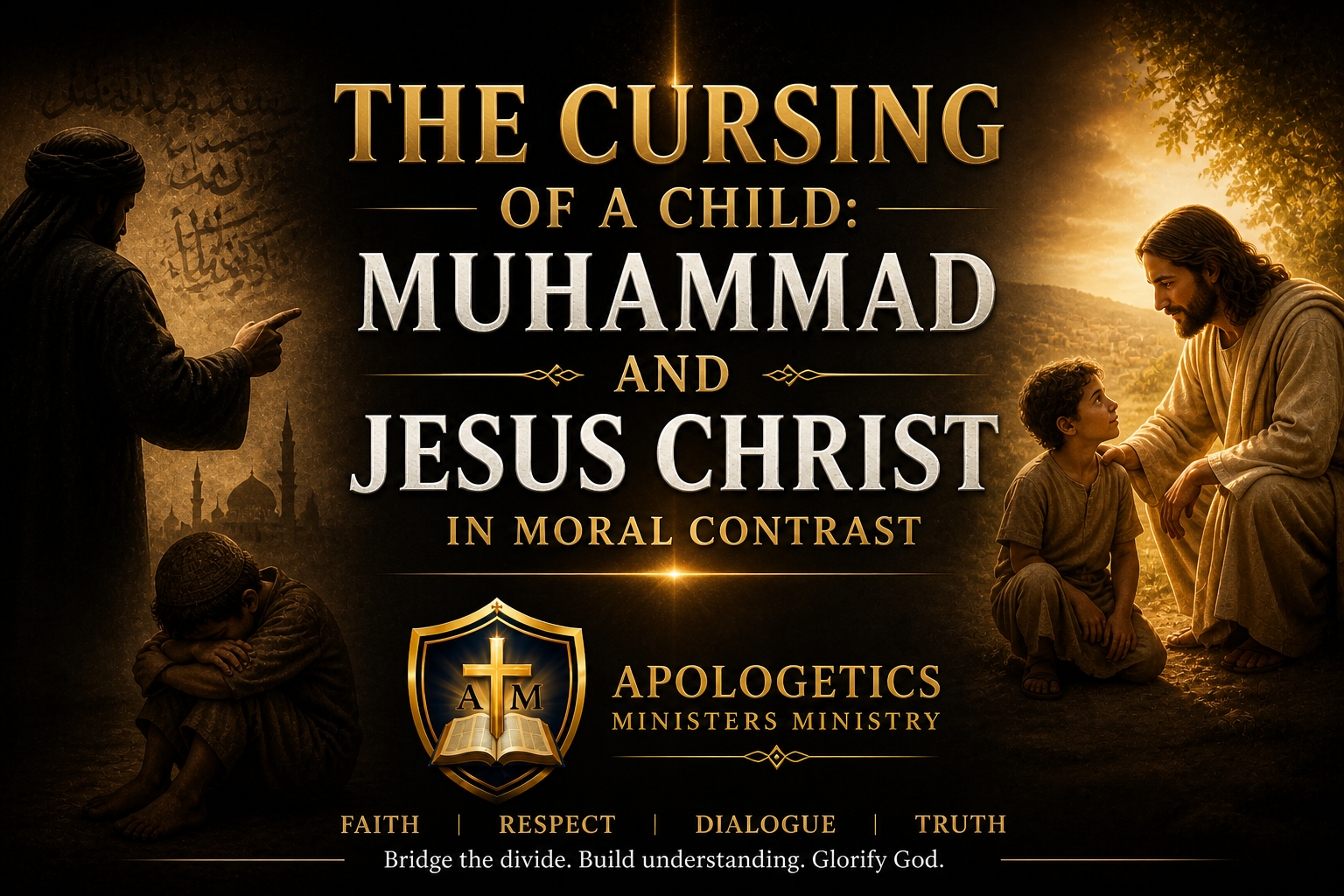

MUHAMMAD, THE CURSING OF A CHILD, AND THE MORAL CONTRAST WITH JESUS CHRIST
Introduction: Moral Authority and the Treatment of the Weak
Every religious tradition ultimately stands or falls on the moral character of its central figure. Theology may be debated, doctrines may be interpreted, and rituals may vary, but moral example speaks directly to the conscience. A true moral role model is revealed not in moments of triumph, power, or victory, but in how he treats the weakest members of society—the poor, the powerless, and especially children.
Children occupy a unique moral space. Across cultures and civilizations, they are recognized as vulnerable, impressionable, and deserving of protection. Words spoken to children, particularly by authority figures, shape their understanding of safety, fear, worth, and destiny. When those words come from a prophet or religious leader, they carry even greater weight.
This chapter examines a troubling narration found in Sahih Muslim, one of Islam’s most authoritative hadith collections, in which Muhammad addresses a young girl with words that function as a curse, causing her distress. This incident is then contrasted with the consistent teaching and example of Jesus Christ, whose interaction with children reveals a fundamentally different moral vision.
The Hadith in Sahih Muslim: Text and Reference
The report under discussion is recorded in:
Sahih Muslim 2603
Anas b. Malik reported that there was an orphan girl with Umm Sulaim (who was the mother of Anas). Allah’s Messenger (ﷺ) saw that orphan girl and said:
O, it is you; you have grown young. May you not advance in years! That slave-girl returned to Umm Sulaim weeping. Umm Sulaim said: O daughter, what is the matter with you? She said: Allah’s Apostle (ﷺ) has invoked curse upon me that I should not grow in age and thus I would never grow in age, or she said, in my (length) of life. Umm Sulaim went out wrapping her head-dress hurriedly until she met Allah’s Messenger (ﷺ). He said to her: Umm Sulaim, what is the matter with you? She said: Allah’s Apostle, you invoked curse upon my orphan girl. He said: Umm Sulaim, what is that? She said: She (the orphan girl) states you have cursed her saying that she might not grow in age or grow in life. Allah’s Messenger (ﷺ) smiled and then said: Umm Sulaim, don’t you know that I have made this term with my Lord. And the term with my Lord is that I said to Him: 1 am a human being and I am pleased just as a human being is pleased and I lose temper just as a human being loses temper, so for any person from amongst my Ummah whom I curse and he in no way deserves it, let that, O Lord, be made a source of purification and purity and nearness to (Allah) on the Day of Resurrection.
حَدَّثَنِي زُهَيْرُ بْنُ حَرْبٍ، وَأَبُو مَعْنٍ الرَّقَاشِيُّ – وَاللَّفْظُ لِزُهَيْرٍ – قَالاَ حَدَّثَنَا عُمَرُ، بْنُ يُونُسَ حَدَّثَنَا عِكْرِمَةُ بْنُ عَمَّارٍ، حَدَّثَنَا إِسْحَاقُ بْنُ أَبِي طَلْحَةَ، حَدَّثَنِي أَنَسُ بْنُ مَالِكٍ، قَالَ كَانَتْ عِنْدَ أُمِّ سُلَيْمٍ يَتِيمَةٌ وَهِيَ أُمُّ أَنَسٍ فَرَأَى رَسُولُ اللَّهِ صلى الله عليه وسلم الْيَتِيمَةَ فَقَالَ ” آنْتِ هِيَهْ لَقَدْ كَبِرْتِ لاَ كَبِرَ سِنُّكِ ” . فَرَجَعَتِ الْيَتِيمَةُ إِلَى أُمِّ سُلَيْمٍ تَبْكِي فَقَالَتْ أُمُّ سُلَيْمٍ مَا لَكِ يَا بُنَيَّةُ قَالَتِ الْجَارِيَةُ دَعَا عَلَىَّ نَبِيُّ اللَّهِ صلى الله عليه وسلم أَنْ لاَ يَكْبَرَ سِنِّي فَالآنَ لاَ يَكْبَرُ سِنِّي أَبَدًا – أَوْ قَالَتْ قَرْنِي – فَخَرَجَتْ أُمُّ سُلَيْمٍ مُسْتَعْجِلَةً تَلُوثُ خِمَارَهَا حَتَّى لَقِيَتْ رَسُولَ اللَّهِ صلى الله عليه وسلم فَقَالَ لَهَا رَسُولُ اللَّهِ صلى الله عليه وسلم ” مَا لَكِ يَا أُمَّ سُلَيْمٍ ” . فَقَالَتْ يَا نَبِيَّ اللَّهِ أَدَعَوْتَ عَلَى يَتِيمَتِي قَالَ ” وَمَا ذَاكِ يَا أُمَّ سُلَيْمٍ ” . قَالَتْ زَعَمَتْ أَنَّكَ دَعَوْتَ أَنْ لاَ يَكْبَرَ سِنُّهَا وَلاَ يَكْبَرَ قَرْنُهَا – قَالَ – فَضَحِكَ رَسُولُ اللَّهِ صلى الله عليه وسلم ثُمَّ قَالَ ” يَا أُمَّ سُلَيْمٍ أَمَا تَعْلَمِينَ أَنَّ شَرْطِي عَلَى رَبِّي أَنِّي اشْتَرَطْتُ عَلَى رَبِّي فَقُلْتُ إِنَّمَا أَنَا بَشَرٌ أَرْضَى كَمَا يَرْضَى الْبَشَرُ وَأَغْضَبُ كَمَا يَغْضَبُ الْبَشَرُ فَأَيُّمَا أَحَدٍ دَعَوْتُ عَلَيْهِ مِنْ أُمَّتِي بِدَعْوَةٍ لَيْسَ لَهَا بِأَهْلٍ أَنْ تَجْعَلَهَا لَهُ طَهُورًا وَزَكَاةً وَقُرْبَةً يُقَرِّبُهُ بِهَا مِنْهُ يَوْمَ الْقِيَامَةِ ” . وَقَالَ أَبُو مَعْنٍ يُتَيِّمَةٌ . بِالتَّصْغِيرِ فِي الْمَوَاضِعِ الثَّلاَثَةِ مِنَ الْحَدِيثِ .
The narration, in substance, states that Muhammad said to a young girl from the Ansar:
“May you not grow old”
(لا كبرت سنك)
According to the report, the girl understood this statement as a serious supplication against her life or future. She returned to her family weeping, believing that Muhammad had invoked harm upon her. When informed of her distress, Muhammad attempted to reassure her by explaining that he had made a general prayer asking Allah to turn any curse or harsh word he uttered against a believer into mercy or purification.
This narration is not isolated speculation, nor is it found in a marginal or weak source. Sahih Muslim, alongside Sahih al-Bukhari, is regarded in Sunni Islam as the most reliable collection of hadith. As such, the report cannot be dismissed without undermining the very foundations of hadith authority.
Why This Hadith Matters
Some may be tempted to view this narration as insignificant—merely a passing remark or cultural expression. But such a dismissal fails to grasp the seriousness of the issue for several reasons.
First, Muhammad is presented in Islam as uswatun ḥasanah, the “excellent example” for all believers (Qur’an 33:21). His conduct is not merely historical; it is normative. What he says and does is studied, imitated, and defended precisely because it is believed to reflect divine guidance.
Second, the subject of the statement is not an enemy, a criminal, or a combatant. It is a child—described in the narration as a young girl from the Ansar. In some scholarly discussions, she is understood to be a servant or orphan, making her even more vulnerable.
Third, the effect of the statement is explicitly stated in the hadith: the girl was distressed and cried. This was not a harmless joke received with laughter. It was experienced as a frightening and harmful utterance.
Thus, the moral question cannot be avoided:
What does it say about a moral role model when his words cause fear and sorrow in a child?
Islamic Explanations and Their Limits
Classical and contemporary Muslim scholars do not deny this narration. Instead, they attempt to reinterpret its implications. The most common explanation is that Muhammad, being human, sometimes spoke sharply or emotionally, but that Allah later corrected or neutralized such speech through Muhammad’s general supplication.
According to this view, any unjust curse uttered by Muhammad would be transformed by Allah into a blessing, mercy, or means of spiritual purification for the believer affected.
While this explanation may appear to preserve Muhammad’s prophetic status, it introduces serious ethical and theological difficulties.
First, it implies that a prophet may speak unjustly, even toward a child, and that God must later intervene to undo the harm. This raises the question: why would God allow His messenger to speak in ways that require correction, especially when Islam presents Muhammad as the final and greatest prophet?
Second, it shifts the moral focus away from the act itself. The issue is not merely whether the curse “worked,” but whether it should have been spoken at all. A moral role model is judged not only by outcomes, but by intent, tone, and character.
Third, the explanation does nothing to address the emotional harm inflicted. Even if later reinterpreted as a blessing, the child experienced fear, confusion, and distress. Words cannot be ethically justified simply because they are later redefined.
The Special Status of Children and Orphans
Across biblical revelation, children—especially orphans—are placed under explicit divine protection.
The Old Testament repeatedly warns against harming or mistreating the fatherless:
“Do not mistreat or oppress the widow or the fatherless.”
— Exodus 22:22
“Defend the cause of the fatherless.”
— Isaiah 1:17
The moral logic is clear: power increases responsibility. The weaker the person, the greater the obligation to protect, not intimidate.
To speak words of harm to a child, particularly from a position of religious authority, violates this principle. Even when spoken casually, such words carry disproportionate weight. A prophet’s tongue should be an instrument of comfort and moral clarity, not fear.
Jesus Christ and His Treatment of Children
When we turn to the Gospels, the contrast with Jesus Christ is immediate and striking.
Jesus never cursed a child.
Jesus never frightened a child.
Jesus never spoke words that required later correction or reversal.
Instead, the Gospel writers consistently portray Jesus as welcoming, blessing, and defending children.
“Then little children were brought to Him that He might put His hands on them and pray… But Jesus said, ‘Let the little children come to Me, and do not forbid them; for of such is the kingdom of heaven.’” Matthew 19:13–14
Here, Jesus does not merely tolerate children; He identifies the kingdom of God with them. He treats them as models of humility and trust, not as objects of rebuke.
Jesus goes even further:
“Whoever receives one little child like this in My name receives Me.” Matthew 18:5
To receive a child is, in Jesus’ teaching, to receive Christ Himself. This elevates the moral status of children to the highest possible level.
And then comes the warning:
“If anyone causes one of these little ones who believe in Me to stumble, it would be better for him to have a millstone hung around his neck and to be drowned in the depths of the sea.” Matthew 18:6
Jesus places severe moral accountability on anyone who harms, misleads, or frightens a child. This is not metaphorical exaggeration; it is moral clarity. Children are not to be threatened, cursed, or emotionally wounded—especially by religious leaders.
Words That Reveal Character
Speech reveals character. This truth is affirmed even in the Bible:
“Out of the abundance of the heart the mouth speaks.” Matthew 12:34
A moral exemplar does not merely teach good values; he embodies them instinctively. He does not need later clarification to explain away harmful words. His speech aligns naturally with compassion, wisdom, and restraint.
Jesus’ words consistently produced peace, healing, and assurance:
“The words that I speak to you are spirit, and they are life.” John 6:63
By contrast, the hadith under discussion shows words that produced fear and sorrow, followed by theological repair. This difference is not trivial. It points to two fundamentally different moral orientations.
The Question of the Ideal Role Model
Islam invites humanity to imitate Muhammad in all aspects of life. Christianity invites humanity to follow Jesus Christ.
The question, then, is unavoidable:
Which figure better embodies the moral ideal worthy of imitation?
One figure speaks words to a child that cause distress and later require explanation.
The other embraces children and warns sternly against harming them.
One must be defended through reinterpretation.
The other stands without apology.
One incident may be explained away, but patterns matter. And when patterns are examined, the contrast between Muhammad and Jesus becomes increasingly clear—not only in doctrine, but in moral instinct.