



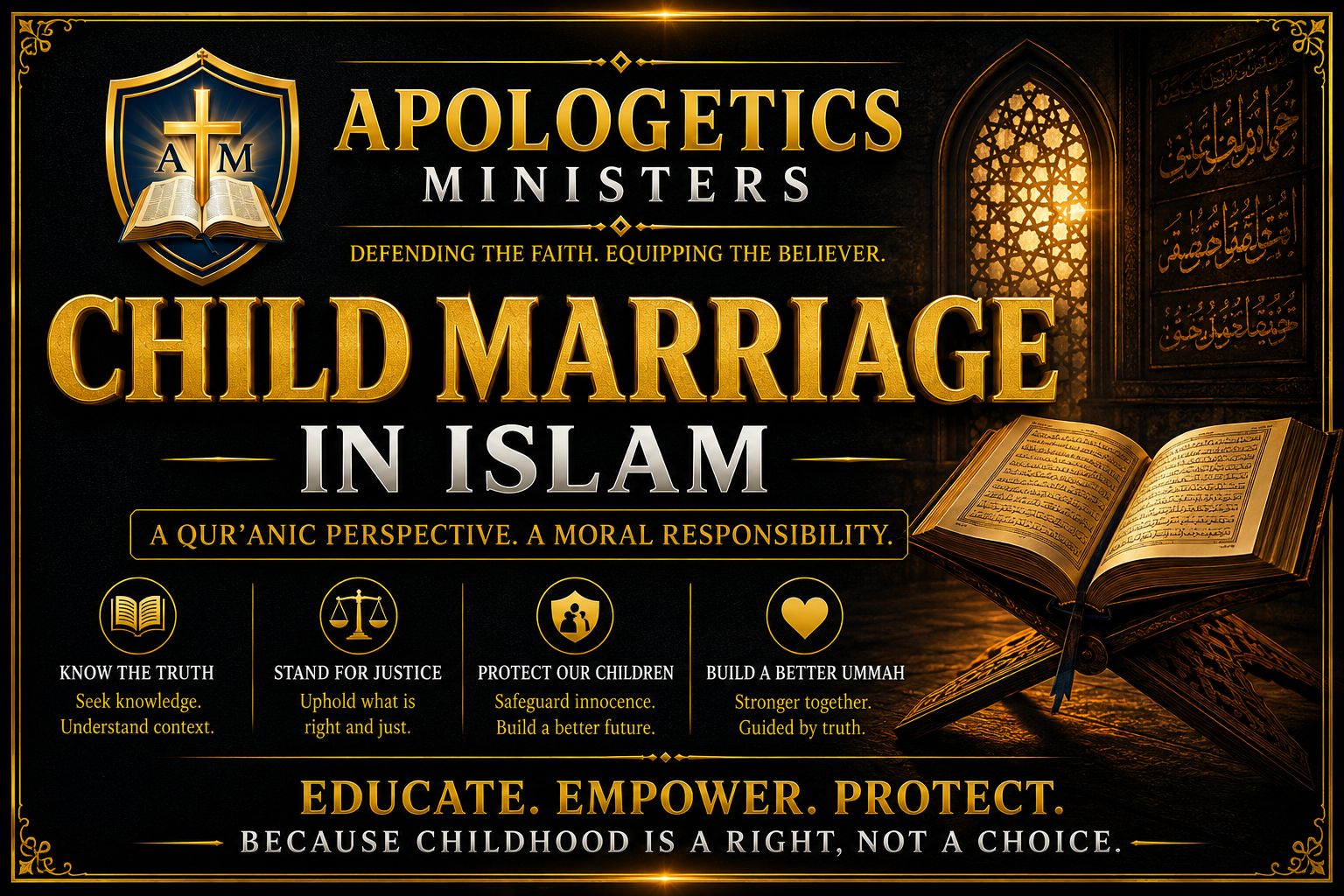

CHILD MARRIAGE IN ISLAM
A Biblical and Historical Examination
I. Introduction
One of the most challenging subjects in Islamic apologetics is the issue of child marriage. Many modern Muslims may deny, avoid, or react defensively to the topic. However, truth should never fear examination. If a religion claims divine origin, its teachings and history must be open to honest investigation.
As Christians, our objective is not to attack individuals, but to examine doctrines, beliefs, and historical claims. Our goal is rooted in a love for truth and compassion for souls. Many believers within Islam have not had the opportunity to study their own classical sources, often relying solely on modern interpretations.
This study is based strictly on:
- The Qur’an
- Classical Tafsir (Exegesis)
- Hadith Literature (Prophetic Traditions)
- Writings of Respected Islamic Jurists
The core question is: “Did classical Islam recognize and permit child marriage?” When the evidence is weighed honestly, the answer becomes difficult to ignore.
II. The Qur’an and Child Marriage
The primary Qur’anic text concerning this issue is Qur’an 65:4, which discusses the waiting period (iddah) required after a divorce before a woman can remarry.
“And those who no longer menstruate among your women, if you doubt, their waiting period is three months; and also for those who have not menstruated…”
— Qur’an 65:4The Key Phrase: “Those who have not menstruated.”
While some modern apologists suggest this refers to adult women with medical conditions, classical Islamic scholars consistently interpreted this differently.Insights from Classical Scholars
- Tafsir al-Tabari: * “Likewise the waiting period of those who have not menstruated because of their young age is three months.” He further notes they are those who “have not reached the age of menstruation, but have touched the earth” (meaning they are born and living).
- Tafsir Ibn Kathir: * “The same for the young, who have not reached the years of menstruation. Their iddah is three months like those in menopause.”
- Tafsir al-Qurtubi: * “This verse proves the legality of marrying young girls who have not yet menstruated.”
- Tafsir al-Jalalayn: * Directly identifies “those who have not menstruated” as being such “because of their young age.”
The Connection with Qur’an 33:49
This verse states that if a man divorces a woman before “touching” (consummating) the marriage, there is no waiting period. By logic, since Qur’an 65:4 mandates a three-month waiting period for girls who have not menstruated, it implies those marriages were intended to be consummated.
III. The Example of Aisha
The historical precedent is most notably found in the marriage of Aisha, daughter of Abu Bakr, to Muhammad. Authentic narrations in the most trusted Hadith collections state:
“The Prophet married me when I was six years old, and consummated the marriage with me when I was nine years old.”
— Sahih al-Bukhari (5134) & Sahih Muslim (1422)For centuries, these narrations were accepted without controversy by Muslim scholars. The modern attempt to re-age Aisha often contradicts the very historical sources that define Islamic tradition.
IV. Classical Islamic Law
The major Sunni schools of law (Madhhabs) historically permitted marriage contracts involving minors.
- The Reliance of the Traveller (Shafi‘i Manual): “A father may marry off his virgin daughter without her permission if she has not reached puberty” (Section m3.13).
- Consummation: While some jurists argued consummation should wait until a girl was “physically capable,” there was no universal minimum age equivalent to modern legal standards.
V. The Biblical Contrast
The Bible presents marriage as a covenant requiring maturity, responsibility, and mutual understanding. Christianity teaches that children are to be protected and nurtured.
The Example of Jesus Christ:
Jesus elevated the dignity of the vulnerable. He did not seek to sexualize children but to bless and protect them.
“Whoever causes one of these little ones who believe in Me to stumble, it would be better for him if a millstone were hung around his neck…” > — Matthew 18:6The Biblical standard is one of protection, purity, and sacrificial love, standing in stark contrast to the normalization of child marriage.
VI. The Modern Crisis
Today, many Muslim-majority nations are raising the legal marriage age due to recognized social and physical dangers. This creates a theological dilemma:
- If child marriage is considered harmful or “wrong” today, was it wrong in the 7th century?
- If Muhammad is the “perfect moral example” (Uswa Hasana) for all time, how can modern societies condemn what he practiced?
Modern apologists are often caught between defending ancient texts and upholding modern human rights standards.VII. Conclusion: A Call to Truth
This examination is not meant to incite hatred. Many Muslims are sincere individuals following their heritage. However, sincerity must be matched with truth. Every seeker should ask:
- Does this reflect the character of a holy God?
- Can a religion built on these examples serve as the final revelation for humanity?
Jesus Christ stands as the alternative. He calls us to a life of holiness, light, and the protection of the weak. True love points toward Christ—the Holy One who never exploited the vulnerable and whose moral standard remains perfect across every generation.