


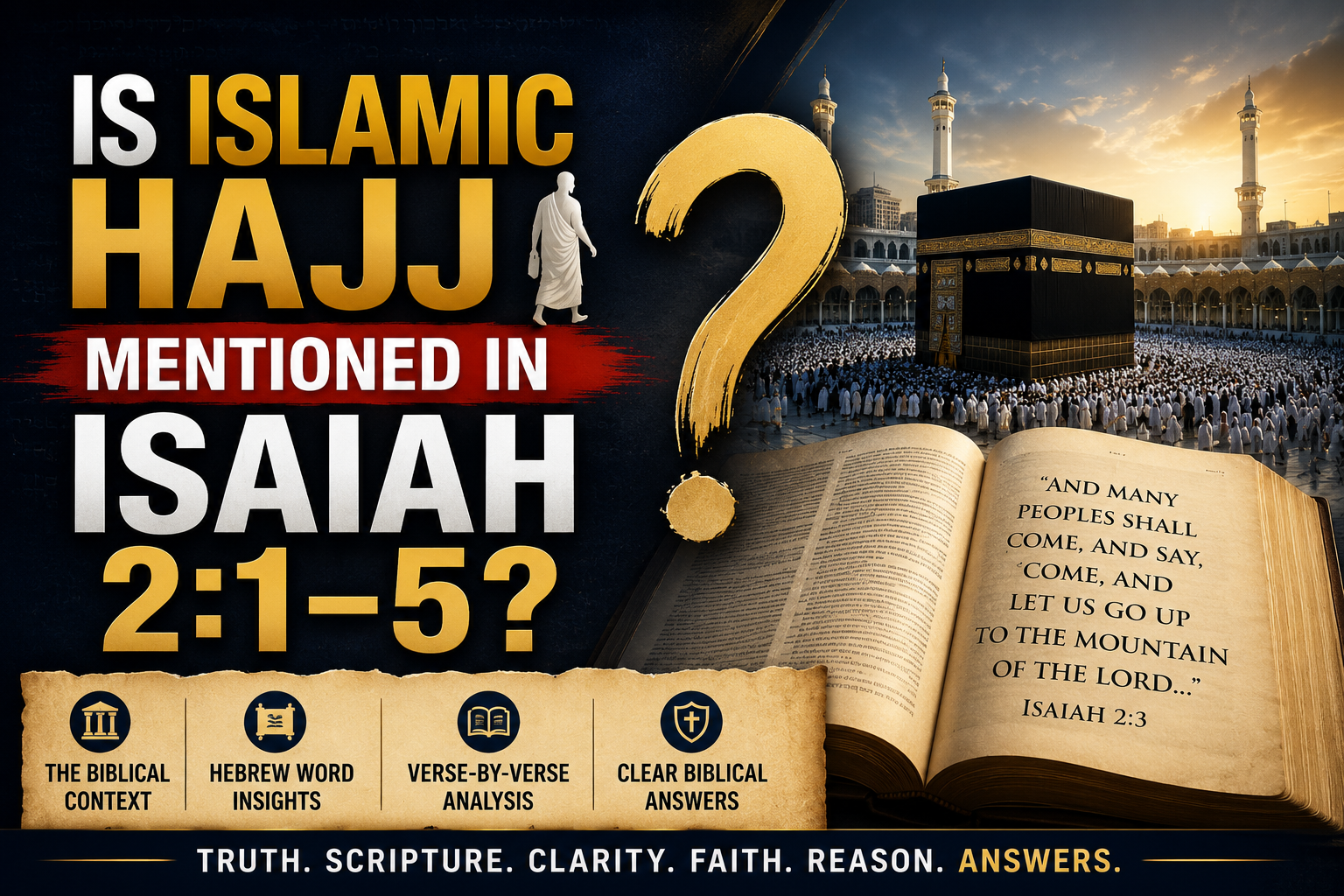

IS ISLAMIC HAJJ MENTIONED IN ISAIAH 2:1–5?
A BIBLICAL AND HISTORICAL REFUTATION OF THE CLAIM THAT ISAIAH PROPHESIED THE ISLAMIC PILGRIMAGE
INTRODUCTION
One of the most frequently repeated claims made by some Muslim apologists is that the Old Testament foretold the Islamic pilgrimage (Hajj) to Mecca centuries before the birth of Muhammad. Among the passages most often cited in support of this assertion is Isaiah 2:1–5. According to this interpretation, Isaiah’s vision of people from all nations traveling to “the mountain of the LORD” is a prophecy of the annual Hajj, where millions of Muslims journey to Mecca. It is further claimed that this passage proves the Bible predicted the rise of Islam long before the seventh century AD.At first glance, this argument may appear convincing to readers who are unfamiliar with the historical and literary context of Isaiah’s prophecy. However, a careful examination of the text reveals a very different picture. Isaiah himself identifies the subject of the prophecy, names the location, specifies the God being worshiped, explains where God’s instruction will proceed from, and describes the purpose of the nations’ pilgrimage. Every one of these details points unmistakably to Jerusalem, not Mecca.The claim that Isaiah 2:1–5 predicts the Islamic Hajj depends upon removing the passage from its historical and literary setting and assigning it a meaning foreign to the prophet’s own words. Sound biblical interpretation requires that Scripture be understood according to its original context, historical background, grammatical structure, and theological purpose. Rather than reading seventh-century Islamic beliefs into an eighth-century BC Hebrew prophecy, we must allow Isaiah to explain his own message.This study examines Isaiah 2:1–5 verse by verse, compares it with related passages throughout Scripture, considers its historical setting, and evaluates the claim that it predicts the Islamic pilgrimage. The evidence demonstrates that Isaiah was not describing Hajj in Mecca but proclaiming the future universal reign of the God of Israel, centered in Jerusalem, where all nations would ultimately acknowledge His sovereign rule.
THE HISTORICAL BACKGROUND OF ISAIAH
Understanding any prophecy begins with understanding the prophet through whom God delivered it.Isaiah was one of the greatest prophets of ancient Israel. According to Isaiah 1:1, he ministered during the reigns of Uzziah, Jotham, Ahaz, and Hezekiah, kings of Judah. His prophetic ministry began around 740 BC and continued for several decades. This means Isaiah lived nearly thirteen centuries before the birth of Muhammad and almost eighteen hundred years before Islam emerged as a world religion.Isaiah lived and ministered in Jerusalem, the capital city of the Kingdom of Judah. His prophetic message focused primarily on Judah, Jerusalem, the surrounding nations, and God’s unfolding plan of redemption. Throughout his book he repeatedly speaks of Mount Zion, the Temple, the Davidic kingdom, the coming Messiah, and the future restoration of Israel. These themes form the foundation of his prophetic ministry.During Isaiah’s lifetime, the Assyrian Empire was rapidly expanding, threatening the political stability of the ancient Near East. Many nations faced invasion, destruction, and exile. Judah itself struggled with spiritual decline, injustice, idolatry, and political uncertainty. Yet amid these dark circumstances, Isaiah proclaimed a message of hope. He declared that God would ultimately establish His righteous kingdom, judge the nations, send the promised Messiah, and gather people from every nation to worship Him.This historical setting is crucial. Nothing within Isaiah’s world points toward Mecca or an Arabian pilgrimage. Mecca is never mentioned anywhere in the Book of Isaiah. Arabia is mentioned elsewhere in the book (Isaiah 21:13–17), but it is clearly distinguished from Judah and Jerusalem. Had Isaiah intended to direct his readers’ attention toward Arabia, he possessed the vocabulary to do so. Instead, he consistently focuses on Jerusalem as the center of God’s redemptive purposes.
THE LITERARY CONTEXT OF ISAIAH 2
A fundamental principle of biblical interpretation is that no verse should ever be separated from its immediate context.Isaiah chapter 1 presents God’s indictment against Judah. The nation had rebelled against the Lord through idolatry, injustice, empty religious rituals, and moral corruption. God called His people to repentance, exposing their hypocrisy while promising forgiveness to those who genuinely turned back to Him.Chapter 2 introduces a dramatic contrast. Instead of describing Judah’s present corruption, Isaiah now reveals her glorious future. Looking ahead to “the latter days,” he describes the time when Jerusalem will become the spiritual center of the world under God’s righteous reign.The transition between the two chapters is intentional and significant. Chapter 1 emphasizes judgment because of sin; chapter 2 emphasizes restoration because of God’s grace. The entire section concerns God’s future dealings with Jerusalem. The narrative never shifts from Jerusalem to Mecca, nor does it introduce another religious system. The context remains firmly centered upon Zion throughout the prophecy.
ISAIAH 2:1— THE SUBJECT OF THE PROPHECY
The prophecy begins with a clear introductory statement:«”The word that Isaiah the son of Amoz saw concerning Judah and Jerusalem.”»This opening verse establishes the subject of everything that follows.Isaiah leaves no room for speculation. He explicitly tells his readers that the vision concerns Judah and Jerusalem. These opening words function as the framework through which the entire prophecy must be understood.This immediately creates a significant difficulty for the claim that Isaiah was predicting the Islamic pilgrimage to Mecca. If the Holy Spirit intended this prophecy to describe Mecca, why would He introduce it as a vision concerning Judah and Jerusalem? Throughout Scripture, introductory statements identify the subject matter of a prophecy. They are not ornamental titles but essential interpretive guides.Some Muslim apologists suggest that although the prophecy begins with Jerusalem, it later shifts its focus to Mecca. Yet nothing in the text indicates such a transition. On the contrary, Jerusalem continues to dominate the passage, both explicitly and implicitly, from beginning to end.Therefore, the very first verse already establishes that the prophecy belongs within the historical and theological context of Jerusalem.
ISAIAH 2:2 — THE MOUNTAIN OF THE LORD’S HOUSE
Isaiah continues:«”And it shall come to pass in the latter days, that the mountain of the LORD’S house shall be established in the top of the mountains, and shall be exalted above the hills; and all nations shall flow unto it.”»This verse is frequently quoted in isolation by those who claim it predicts the Islamic Hajj. However, such an interpretation overlooks the most important details contained within the verse itself.The destination is clearly identified.It is the mountain of the LORD’S house.The word translated LORD represents the divine covenant name YHWH (Yahweh), the name by which God revealed Himself to Moses at the burning bush (Exodus 3:15). Isaiah is therefore speaking specifically about Yahweh, the covenant God of Israel.Likewise, the expression “the LORD’S house” has a well-established meaning throughout the Old Testament. It consistently refers to the Temple in Jerusalem.King Solomon built “the house of the LORD” on Mount Moriah (2 Chronicles 3:1). Throughout Israel’s history, faithful Israelites traveled there during the appointed feasts to worship the Lord (Psalm 122). Isaiah himself later refers to the Temple as God’s house (Isaiah 56:7).Nowhere in the Old Testament is this expression ever applied to the Kaaba in Mecca.Had Isaiah intended his readers to think of a sanctuary located hundreds of miles away in Arabia, he would have needed to explain such an extraordinary shift. Instead, every Israelite hearing this prophecy would naturally have understood “the LORD’S house” to mean the Temple in Jerusalem.The identity of the location is therefore established by the prophet himself, not by later interpretation.
WHAT DOES “THE LATTER DAYS” MEAN?
Some Muslim writers argue that the phrase “the latter days” proves Isaiah was predicting the rise of Islam.This conclusion does not follow from the biblical text.The expression “the latter days” appears numerous times throughout the Old Testament. It refers broadly to God’s future redemptive purposes and the establishment of His kingdom.Jacob used the phrase while blessing his sons (Genesis 49:1). Moses employed it when speaking of Israel’s future restoration (Deuteronomy 4:30). Daniel repeatedly used it in relation to God’s sovereign kingdom and His final purposes for history.In none of these passages does the phrase refer to the coming of Islam or the establishment of the Islamic pilgrimage.Instead, it consistently points to God’s unfolding plan of redemption, culminating in the reign of the promised Messiah.Consequently, the phrase “the latter days” provides no evidence that Isaiah was speaking about Muhammad or the institution of Hajj.
WHY DO THE NATIONS FLOW TO JERUSALEM?
Isaiah declares that “all nations shall flow unto it.”This remarkable expression deserves careful attention.Ordinarily, rivers flow downward.Isaiah reverses the imagery by describing nations flowing upward toward God’s holy mountain. The picture emphasizes God’s irresistible authority as He draws the peoples of the world to Himself.More importantly, Isaiah does not merely describe people traveling. He explains why they travel.Their journey is not motivated by commerce.It is not tourism.It is not political diplomacy.Nor is it the performance of ceremonial rituals.The nations come because they recognize the supreme authority of the God of Israel and desire to submit themselves to His rule.This point becomes even clearer in the next verse, where the nations themselves explain the purpose of their pilgrimage. Isaiah 2:3 will prove to be the decisive evidence against the claim that this prophecy refers to the Islamic Hajj.
ISAIAH 2:3—THE STRONGEST EVIDENCE AGAINST THE HAJJ INTERPRETATION
Isaiah 2:3 forms the heart of the prophecy. While some Muslim apologists focus almost entirely on the statement that “all nations shall flow unto it” in verse 2, they often overlook the details contained in verse 3. Yet it is precisely these details that identify the destination, the God being worshiped, the purpose of the gathering, and the source of divine revelation. When read carefully, every element points unmistakably to Jerusalem and not to Mecca.Isaiah writes:«”And many people shall go and say, Come ye, and let us go up to the mountain of the LORD, to the house of the God of Jacob; and He will teach us of His ways, and we will walk in His paths: for out of Zion shall go forth the law, and the word of the LORD from Jerusalem.” (Isaiah 2:3)»This single verse contains some of the strongest evidence against the claim that Isaiah was predicting the Islamic pilgrimage.
“MANY PEOPLE SHALL GO”
Isaiah begins by describing people from many nations encouraging one another to worship the true God. This fulfills God’s promise to Abraham that through his descendants all nations of the earth would be blessed (Genesis 12:1–3).The emphasis is not simply on the act of traveling. Throughout history, people have journeyed to countless temples, shrines, and sacred places belonging to various religions. The fact that people from many nations gather at one location does not, by itself, prove that Isaiah is describing Hajj.The real questions are these:Where are they going?Why are they going?Whom are they going to worship?Isaiah answers each of these questions with remarkable clarity.
“COME, LET US GO UP”
The invitation, “Come, let us go up,” reflects familiar biblical language concerning Jerusalem.Throughout the Old Testament, people were said to “go up” to Jerusalem because of both its physical elevation and its unique position as God’s chosen city. Pilgrims ascended to Jerusalem during Israel’s appointed feasts, and this language became a common expression of worship.Jeremiah declared,«”Come, and let us go up to Zion unto the LORD our God.” (Jeremiah 31:6)»The psalmist likewise celebrated the privilege of entering Jerusalem, saying,«”Our feet shall stand within thy gates, O Jerusalem.” (Psalm 122:2)»During His earthly ministry, Jesus Himself repeatedly “went up to Jerusalem” to observe the Jewish festivals and fulfill His mission (Matthew 20:17–18; John 5:1).Thus, the expression “go up” naturally directs the reader’s attention to Jerusalem. It is standard biblical language and does not uniquely describe Mecca or the Islamic pilgrimage.
“THE MOUNTAIN OF THE LORD”
Isaiah again repeats the phrase first introduced in verse 2:«”The mountain of the LORD.”»The repetition is intentional. In Hebrew literature, repetition often emphasizes an important theme.The word translated LORD represents the divine covenant name YHWH (Yahweh). Isaiah is therefore speaking specifically of Yahweh’s holy mountain.Throughout the Old Testament, Yahweh’s mountain is consistently identified as Mount Zion.Psalm 48:1–2 declares:«”Great is the LORD, and greatly to be praised in the city of our God, in the mountain of His holiness. Beautiful for situation, the joy of the whole earth, is Mount Zion.”»Likewise, Joel proclaims:«”So shall ye know that I am the LORD your God dwelling in Zion, My holy mountain.” (Joel 3:17)»The biblical evidence is consistent. God’s holy mountain is Zion in Jerusalem, not Mecca in Arabia.No Old Testament writer identifies Mecca as Yahweh’s holy mountain, nor does any biblical prophet connect the covenant name of God with the Kaaba.Therefore, Isaiah’s original audience could only have understood this expression as referring to Mount Zion.
“THE HOUSE OF THE GOD OF JACOB”
Perhaps the most decisive phrase in the entire prophecy is this one:«”The house of the God of Jacob.”»Isaiah does not merely refer to God in a general sense. He identifies Him specifically as the God of Jacob.This title is deeply rooted in God’s covenant relationship with Israel.Jacob was the grandson of Abraham and the father of the twelve tribes of Israel. Throughout the Old Testament, God repeatedly identifies Himself as:- The God of Abraham.- The God of Isaac.- The God of Jacob.These covenant titles appear throughout Genesis, Exodus, Deuteronomy, the Psalms, the Prophets, and many other portions of Scripture. They remind God’s people that He is the covenant God who chose Israel and established His promises through Abraham’s family.The Temple in Jerusalem belonged to the God of Jacob.The covenant was established with the descendants of Jacob.The priesthood ministered before the God of Jacob.The sacrifices were offered to the God of Jacob.The prophets spoke in the name of the God of Jacob.Nothing in the Old Testament connects the Kaaba with the covenant God of Jacob.If Isaiah had intended to describe a future pilgrimage to Mecca, why would he deliberately identify the destination as the house of the God of Jacob rather than using language that pointed toward Arabia?The answer is simple.Because Isaiah is speaking about Jerusalem.
THE COVENANT CONTEXT CANNOT BE IGNORED
Some Muslim apologists argue that Allah is simply another name for the God of Abraham and therefore Isaiah’s prophecy naturally applies to Islam.However, Isaiah is not making a broad statement about belief in one God. He is speaking within the specific framework of God’s covenant with Israel.The God of Jacob revealed Himself to Moses.He established His covenant at Mount Sinai.He commanded the construction of the Tabernacle and later the Temple in Jerusalem.He chose David and promised that the Messiah would come through David’s royal line.These historical realities define Isaiah’s prophecy.To remove Isaiah 2 from this covenant context is to remove the prophecy from the very foundation upon which it stands.
“HE WILL TEACH US HIS WAYS”
The nations now explain why they are making the journey.Notice carefully what they do not say.They do not say,”We are going to perform religious ceremonies.”They do not say,”We are going to complete a pilgrimage.”They do not say,”We are going to carry out sacred rituals.”Instead they declare,«”He will teach us of His ways.”»This statement shifts the emphasis from ritual to revelation.Their purpose is to receive God’s instruction.They desire to learn His truth.They long to understand His ways.They intend to obey His commands.This perfectly reflects the Old Testament understanding of Jerusalem as the center of divine instruction.The priests taught God’s law.The Levites instructed the people.The prophets proclaimed God’s Word.Jerusalem was not merely the location of sacrifices; it was the place where God’s truth was revealed to His covenant people.Isaiah therefore describes a worldwide movement of people seeking God’s instruction, not the performance of a particular religious ceremony.
“WE WILL WALK IN HIS PATHS”
Receiving God’s instruction naturally leads to obedience.The nations are not merely curious observers.They do not travel simply to witness impressive ceremonies.Instead, they commit themselves to living according to God’s will.Throughout the Scriptures, walking represents one’s daily manner of life.To “walk in God’s ways” means to obey His commandments, pursue righteousness, and live according to His revealed truth.The nations therefore experience genuine spiritual transformation.They abandon their former ways.They submit to God’s authority.They embrace His righteous standards.This emphasis is significant.Isaiah focuses on lifelong obedience that flows from receiving God’s instruction.His concern is not the performance of temporary religious rituals but the transformation of human lives through the knowledge of God.This is one of the central themes of the prophecy.
“OUT OF ZION SHALL GO FORTH THE LAW”
This statement completely undermines the claim that Isaiah was predicting the Islamic Hajj.Isaiah explains why the nations come.They come because,«”Out of Zion shall go forth the law.”»The Hebrew word translated law is Torah.Although often translated “law,” the word carries a broader meaning. It refers to God’s instruction, teaching, guidance, and revealed truth.Throughout the Old Testament, the Torah belongs to Israel.God gave it through Moses.Israel became its guardian.The priests taught it.The prophets defended it.Jerusalem became its spiritual center.Isaiah therefore identifies Zion as the source of God’s revealed instruction.He does not point toward Arabia.He does not mention Mecca.He does not speak of another sanctuary.If Isaiah intended to predict Islam, one would reasonably expect him to declare that God’s final revelation would proceed from Mecca.Instead, he states exactly the opposite.God’s instruction proceeds from Zion.That is Isaiah’s own explanation of the prophecy, and it cannot honestly be ignored.