



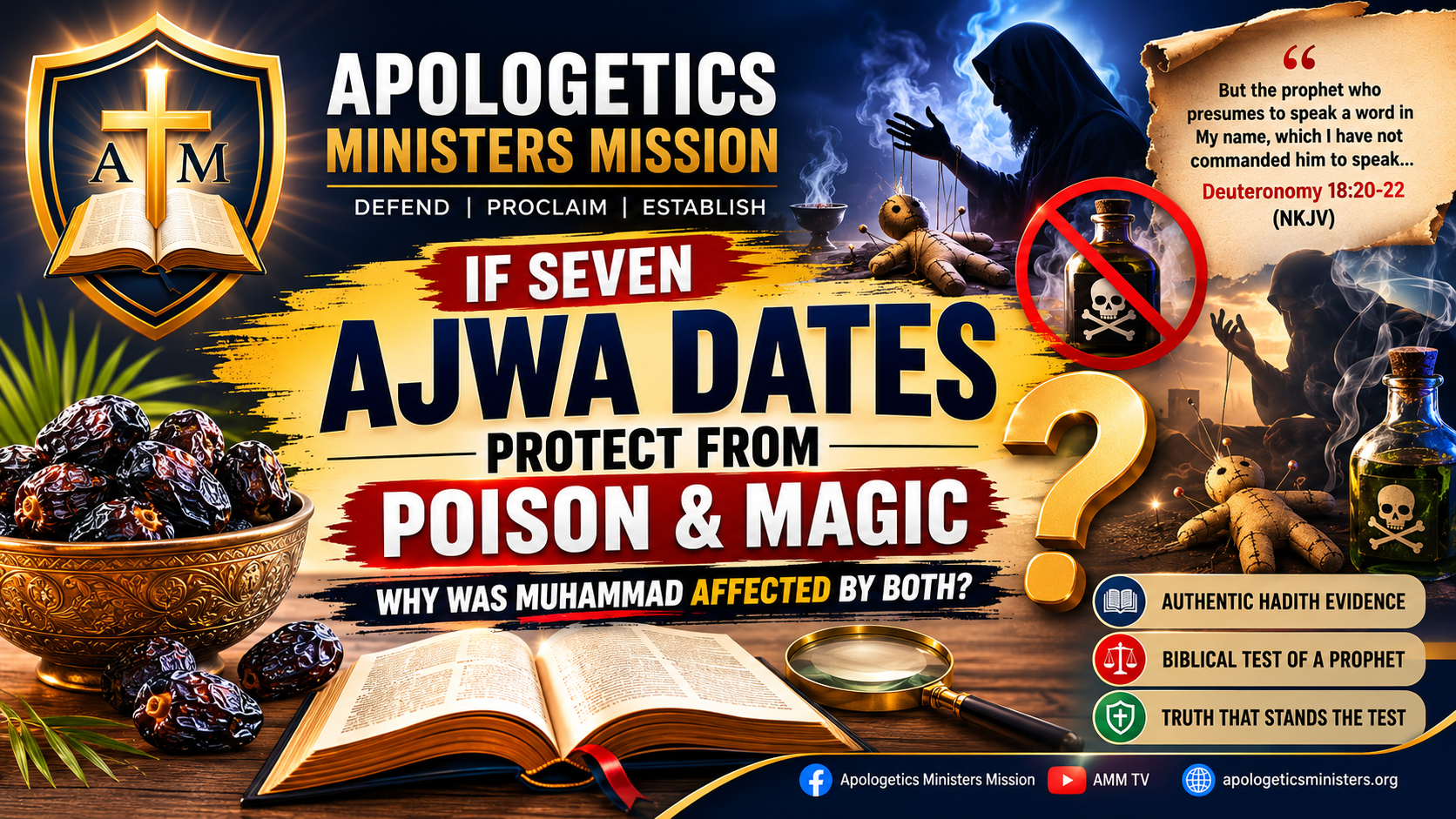

IF SEVEN AJWA DATES PROTECT FROM POISON AND MAGIC, WHY WAS MUHAMMAD AFFECTED BY BOTH?
An Examination of Islamic Sources in Light of Deuteronomy 18:20–22
“Test all things; hold fast what is good.” — 1 Thessalonians 5:21 (NKJV)
One of the distinguishing characteristics of biblical faith is that God invites people to examine evidence rather than follow religious claims blindly. Throughout Scripture, God’s prophets were tested by their message, their character, and the literal fulfillment of their words (Deuteronomy 13:1–5; Deuteronomy 18:20–22). Christians are explicitly encouraged to “test the spirits” (1 John 4:1) and to “test all things.” This theological standard becomes critically important when evaluating the claims of any religious leader asserting divine authority.
A widely cited tradition in Sunni Islam is Muhammad’s teaching concerning the spiritual and physical properties of Ajwa dates. According to authentic Islamic narrations, consuming seven Ajwa dates in the morning provides absolute protection against poison and magic for the rest of the day.
However, the same authoritative collections report that Muhammad himself was severely affected by a magician’s spell and later suffered from the long-term effects of a lethal poison until his death.
This article seeks to fairly examine these core Islamic texts, outline the traditional explanations provided by Muslim scholars, and analyze the data using the biblical standard for verifying a prophet.
1. The Promise of the Seven Ajwa Dates
The primary directive is recorded in Sahih al-Bukhari, universally recognized as the most reliable (Sahih) collection of traditions in Sunni Islam.
Sahih al-Bukhari 5445
Arabic: مَنْ تَصَبَّحَ كُلَّ يَوْمٍ سَبْعَ تَمَرَاتٍ عَجْوَةً لَمْ يَضُرَّهُ فِي ذَلِكَ الْيَوْمِ سُمٌّ وَلَا سِحْرٌ.
English: Narrated Sa’d: Allah’s Messenger (ﷺ) said, “He who eats seven ‘Ajwa dates every morning will not be affected by poison or magic on the day he eats them.”
This definitive statement is reinforced by a secondary narration in the same collection:
Sahih al-Bukhari 5768
“If somebody takes some ‘Ajwa dates every morning, he will not be affected by poison or magic on that day till night.” (Another narrator added, “Seven dates.”)
These textual sources establish a clear, causal link. The instruction is delivered as an absolute promise rather than a prayer, hope, or conditional request:
- The Remedy: Seven Ajwa dates
- The Timing: Consumed in the morning (Tasabbaha)
- The Scope: Complete immunity against both poison and magic for that day.
2. The Historical Reality: Muhammad Was Bewitched
Despite the absolute nature of this promise, authoritative Islamic sources document that Muhammad fell victim to a severe magical spell.
Sahih al-Bukhari 3268 (See also Sahih Muslim 2189)
Narrated Aisha: The Prophet (ﷺ) was bewitched until he imagined that he had done something which he had not actually done…
The texts identify the perpetrator as Labid ibn al-A’sam, a local magician. According to the Hadith, the spell caused significant cognitive distress, making the Prophet believe he had visited his wives or performed actions when he had not, until divine revelation eventually uncovered the location of the hidden charm. Because these reports are graded as universally authentic, the historical event itself is undisputed in classical Sunni scholarship.
3. The Long-Term Trauma: Muhammad Was Poisoned
Years prior to his passing, following the conquest of Khaybar, Muhammad was offered poisoned meat by a Jewish woman named Zainab bint al-Harith. While he spat out the initial bite after realizing it was compromised, he still ingested enough of the toxin to feel its effects.
During his final illness, Muhammad explicitly linked his impending death to the lingering effects of that event.
Sahih al-Bukhari 4428
Narrated Aisha: The Prophet (ﷺ) in his fatal illness used to say, “O ‘Aisha! I still feel the pain caused by the food I ate at Khaibar, and now, this is the time when it as if my aorta is being cut because of that poison.”
4. Synthesis of the Islamic Evidence
When laid side-by-side, these three universally accepted Sahih traditions present a clear theological paradox:
[ Fact 1: Seven Ajwa dates guarantee protection from poison/magic. ]
                                 ⬇
[ Fact 2: Muhammad was successfully targeted and afflicted by magic. ]
                                 ⬇
[ Fact 3: Muhammad died from the long-term damage of ingested poison. ]
The juxtaposition of these facts naturally leads to the question: If the remedy was universally effective, how did the teacher of the remedy succumb to the exact dangers it promised to avert?
5. Traditional Islamic Reconciliations
Classical and contemporary Islamic scholars have offered several distinct frameworks to harmonize these narrations:
- The Contextual Absence Argument: Scholars like Ibn Hajar al-Asqalani suggest that Muhammad simply may not have consumed the required seven Ajwa dates on the morning of the Khaybar feast or the morning he was bewitched. Because the texts do not explicitly state whether he ate them on those specific days, this remains an interpretive inference.
- Geographical Specificity: Other commentators point to alternate variations of the tradition found in Sahih Muslim, which mention dates harvested specifically from the Aliya (uplands) of Medina. They argue the protection was a localized medical property of that specific soil during that exact era, rather than a universal rule.
- The Sovereign Decree & Martyrdom Framework: Another prominent view states that Allah allowed these events to bypass normal protections as an exceptional trial. By allowing the poison of Khaybar to ultimately end his life years later, Allah granted Muhammad the highly revered spiritual status of a martyr (Shaheed) alongside his status as a prophet.
6. Testing the Claims by the Biblical Standard
For those evaluating these accounts through the lens of biblical scripture, God provided a concrete, objective standard to determine the authority of a prophetic voice:
Deuteronomy 18:20–22
“But the prophet who presumes to speak a word in My name, which I have not commanded him to speak… when a prophet speaks in the name of the LORD, if the thing does not happen or come to pass, that is the thing which the LORD has not spoken; the prophet has spoken it presumptuously; you shall not be afraid of him.”
The biblical standard is rooted entirely in objective reliability. It asks a fundamental question: When a statement is declared as a matter of spiritual or physical fact, does the reality match the declaration? From a Christian apologetic standpoint, when a teacher provides an absolute spiritual remedy for safety but falls vulnerable to those exact forces, it raises valid questions regarding the ultimate source and foresight of those statements.
7. A Contrast in the Basis of Security
This dynamic highlights a fundamental difference between the ministries of Jesus Christ and Muhammad regarding how believers are taught to find security.
Jesus never directed his followers to place their trust in specific objects, fruits, rituals, or dietary regimens to ward off supernatural harm or physical poison. Instead, the New Testament completely shifts the focus away from external materials and anchors protection solely in the person, authority, and spiritual presence of God Himself.
“I am the way, the truth, and the life. No one comes to the Father except through Me.” — John 14:6
In Christian theology, safety from the powers of darkness or spiritual vulnerability is found exclusively through the indwelling of the Holy Spirit and the relational authority of Christ, who declared that He had already overcome the world.
Conclusion
The textual evidence from the most trusted Islamic sources presents a clear triad of facts:
- A declared promise of total daily protection via seven Ajwa dates.
- A historical account of the Prophet being affected by magic.
- A deathbed testimony linking his mortality to the poison of Khaybar.
While Islamic scholarship offers multiple nuanced parameters—such as timing, geography, and divine exceptions—to resolve this tension, the biblical standard invites a direct comparison between prophetic utterances and historical realities.
Truth has no reason to fear honest investigation. Every sincere seeker of truth is encouraged to examine these sources with humility, weigh the evidence objectively, and compare all external religious claims against the unchanging standard of God’s revealed Word.