



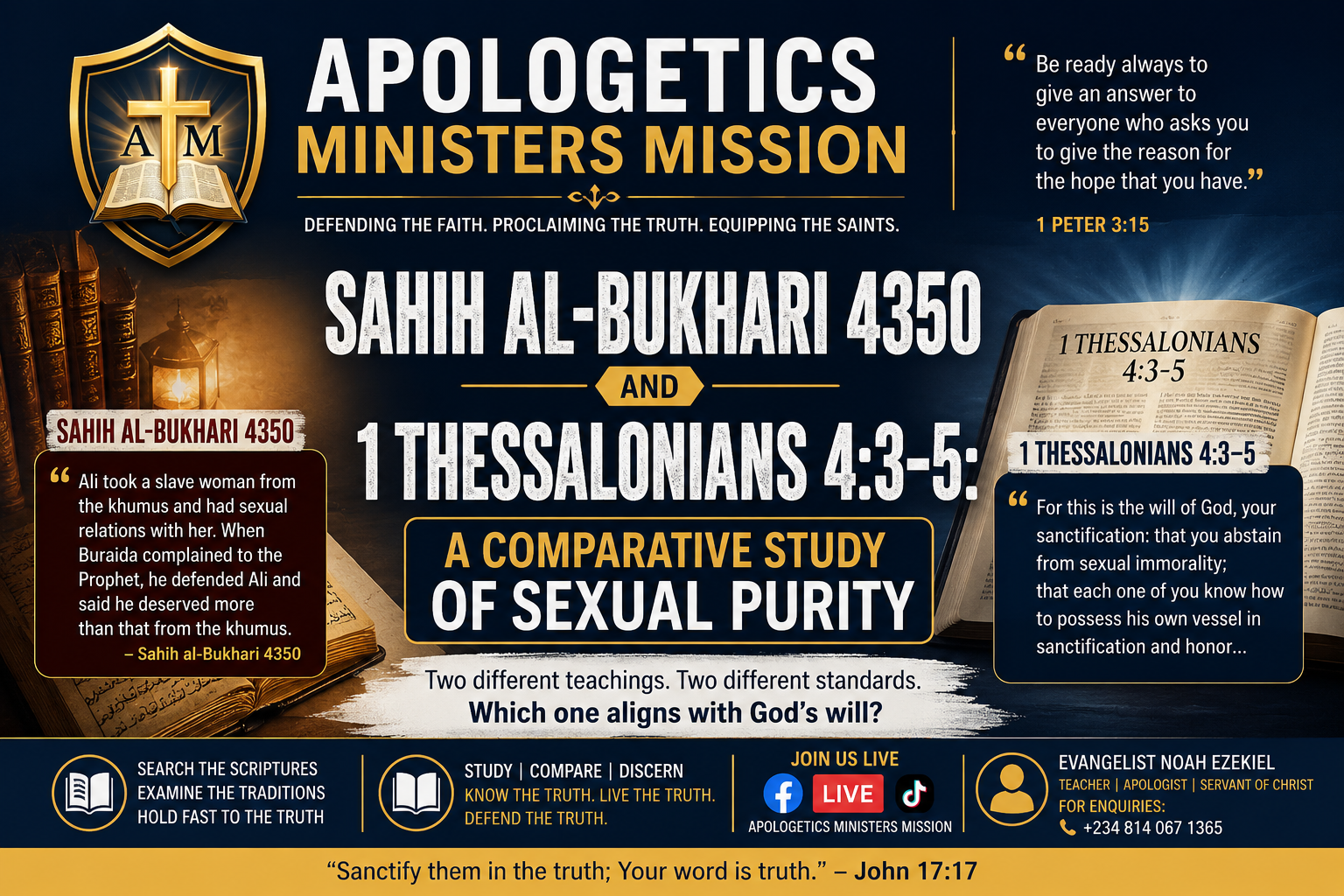

SAHIH AL-BUKHARI 4350 AND 1 THESSALONIANS 4:3–5: A COMPARATIVE STUDY OF SEXUAL PURITY
Introduction
One of the clearest differences between the teachings of the New Testament and the traditions recorded in the Hadith concerns the subject of sexual purity. Christians believe that the life and teachings of Jesus Christ, together with the writings of His apostles, establish God’s standard for holy living. Muslims, on the other hand, accept the Qur’an and the Hadith as authoritative sources of guidance.
This article compares Sahih al-Bukhari 4350 with the teaching of the Apostle Paul in 1 Thessalonians 4:3–5.
Sahih al-Bukhari 4350
Sahih al-Bukhari 4350 records that after a military expedition, Ali took a slave woman from the khumus (the one-fifth share of war booty) and had sexual relations with her. When Buraida complained to Muhammad, Muhammad did not condemn Ali’s action. Instead, he asked Buraida whether he hated Ali and stated that Ali deserved even more than that from the khumus.
The narration presents no rebuke concerning the sexual relationship itself. Rather, the Prophet’s response focuses on Ali’s entitlement to the spoils.
The Teaching of the Apostle Paul
In contrast, Paul writes:
“For this is the will of God, your sanctification: that you abstain from sexual immorality; that each one of you know how to possess his own vessel in sanctification and honor, not in the passion of lust like the Gentiles who do not know God.” (1 Thessalonians 4:3–5)
Paul teaches that:
- God’s will is holiness.
- Believers must abstain from sexual immorality.
- Christians must exercise self-control.
- Sexual desire must be governed by holiness and honor rather than lust.
The emphasis is not on one’s rights or privileges but on purity before God.
A Comparison
The two passages present very different ethical emphases.
In Sahih al-Bukhari 4350, the narrative accepts sexual relations with a female captive who had become part of the war booty, and Muhammad’s response defends Ali’s right regarding the khumus rather than criticizing the act itself.
In 1 Thessalonians 4:3–5, the Apostle Paul calls Christians to a higher standard of sexual holiness, urging believers to control their bodies in sanctification and honor instead of being driven by sexual passion.
One text discusses entitlement connected to war booty, while the other emphasizes moral purity and self-control.
The Christian Standard
The New Testament consistently teaches that the body belongs to God and should be used for His glory. Sexual conduct is to reflect holiness, love, faithfulness, and self-control.
Christians are therefore called not merely to ask, “Is this permitted?” but rather, “Does this honor God?”
Conclusion
This comparison highlights two different moral frameworks. Sahih al-Bukhari 4350 describes an incident in which a companion’s sexual relations with a captive woman were not condemned, while 1 Thessalonians 4:3–5 commands believers to abstain from sexual immorality and to live lives characterized by holiness and honor.
For Christians, the apostolic teaching remains the standard for sexual ethics. Every believer is called to pursue purity, exercise self-control, and honor God with both body and spirit.