



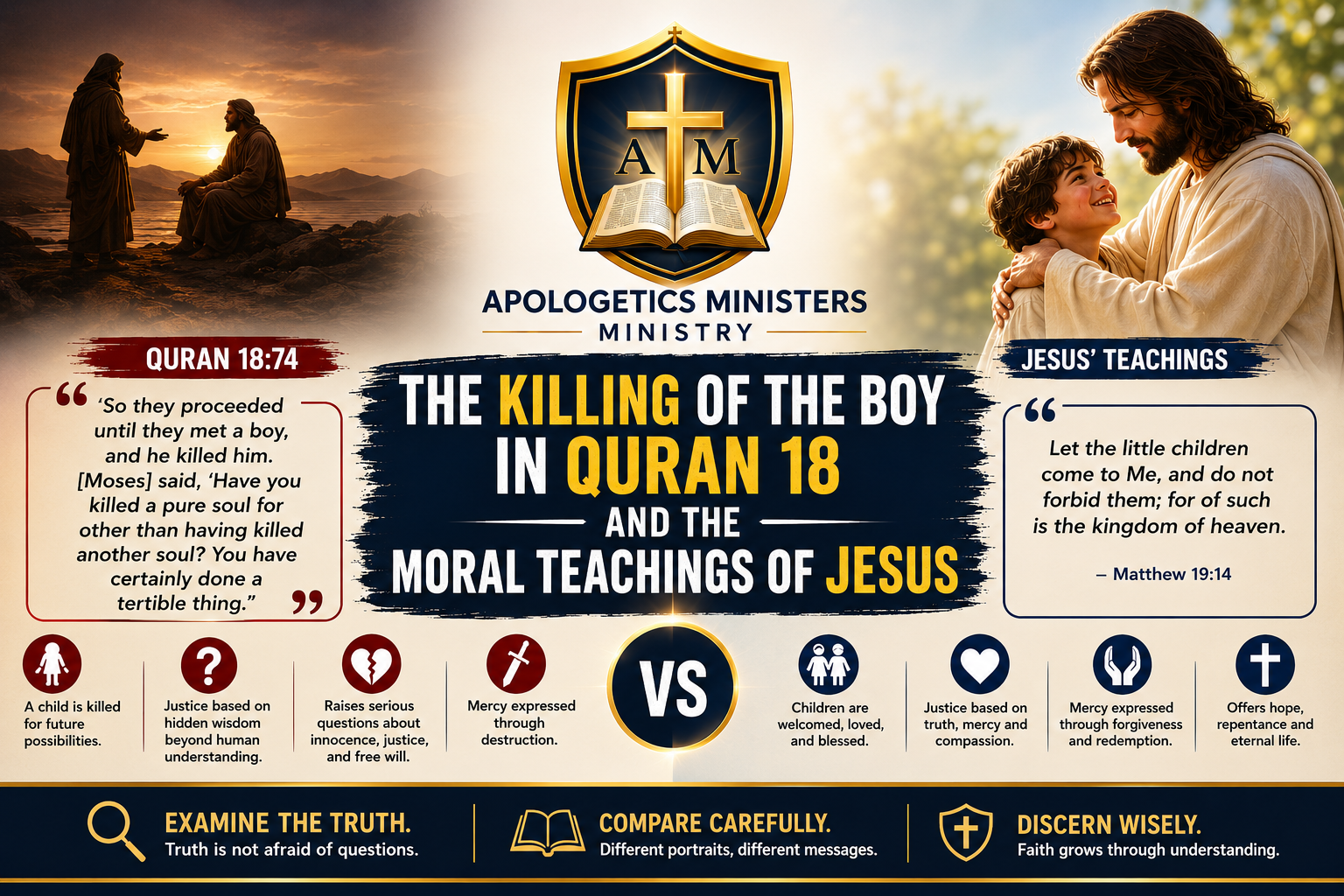

THE KILLING OF THE BOY IN QURAN 18 AND THE MORAL TEACHINGS OF JESUS
The story recorded in Quran 18:60–82 is one of the most controversial and emotionally difficult narratives in Islamic scripture. It contains the journey of Musa, known in the Bible as Moses, with a mysterious servant of Allah traditionally identified in Islamic tafsir as Al-Khidr. During this journey, several shocking actions occur. A boat belonging to poor people is damaged, a young boy is killed, and a wall is repaired without payment. Musa repeatedly questions these actions because they appear unjust and morally troubling. Among all these events, the killing of the boy stands as the most serious moral challenge.
Quran 18:74 states:
“So they proceeded until they met a boy, and he killed him. [Moses] said, ‘Have you killed a pure soul for other than having killed another soul? You have certainly done a terrible thing.’”
This reaction from Musa is extremely important. Musa did not celebrate the killing. He did not immediately assume hidden wisdom. Instead, he reacted with shock and moral outrage. He described the child as “a pure soul” and openly condemned the act as terrible. The narrative itself therefore acknowledges the moral seriousness of what occurred.
Later in the story, Al-Khidr explains the reason behind the killing.
Quran 18:80–81 says:
“And as for the boy, his parents were believers, and we feared that he would overburden them by transgression and disbelief. So we intended that their Lord should substitute for them one better than him in purity and nearer to mercy.”
Classical Muslim commentators such as Ibn Kathir and Al-Tabari explain that the child would eventually become wicked and would lead his believing parents into suffering or disbelief. Therefore, according to the story, Allah commanded Al-Khidr to kill the child before such corruption could occur.
TAFSIR IBN KATHIR
Interpretation of why the Boy was killed
Ibn `Abbas narrated from Ubayy bin Ka`b that the Prophet said:
«الْغُلَامُ الَّذِي قَتَلَهُ الْخَضِرُ طُبِعَ يَوْمَ طُبِعَ كَافِرًا»
(The boy Al-Khidr killed was destined to be a disbeliever from the day he was created.) It was recorded by Ibn Jarir from Ibn `Abbas. He said:
فَكَانَ أَبَوَاهُ مُؤْمِنَيْنِ فَخَشِينَآ أَن يُرْهِقَهُمَا طُغْيَـناً وَكُفْراً
(his parents were believers, and we feared he would oppress them by rebellion and disbelief) Their love for him might make them follow him in disbelief. Qatadah said, “His parents rejoiced when he was born and grieved for him when he was killed. If he had stayed alive, he would have been the cause of their doom. So let a man be content with the decree of Allah, for the decree of Allah for the believer, if he dislikes it, is better for him than if He were to decree something that he likes for him.” An authentic Hadith says;
«لَا يَقْضِي اللهُ لِلْمُؤْمِنِ مِنْ قَضَاءٍ إِلَّا كَانَ خَيْرًا لَه»
(Allah does not decree anything for the believer except it is good for him.) And Allah says:
وَعَسَى أَن تَكْرَهُواْ شَيْئًا وَهُوَ خَيْرٌ لَّكُمْ
(and it may be that you dislike a thing which is good for you.) 2:216.
فَأَرَدْنَآ أَن يُبْدِلَهُمَا رَبُّهُمَا خَيْراً مِّنْهُ زَكَـوةً وَأَقْرَبَ رُحْماً
(So we intended that their Lord should exchange him for them for one better in righteousness and nearer to mercy. ) A child who was better than this one, a child for whom they would feel more compassion. This was the view of Ibn Jurayj.
TAFSIR TABARI
God Almighty says: As for the boy, he was an unbeliever, while his parents were believers, so We knew that he would burden them. He says: He would overwhelm them with transgression, which is arrogance towards God and disbelief in Him. Those who interpret the Quran have said something similar to what we have said about this. This has been mentioned in some versions. As for the boy, he was an unbeliever. Those who said this include: Al-Hasan ibn Yahya, who said: Abd al-Razzaq told us, who said: Ma’mar told us, on the authority of Qatadah: “As for the boy, he was an unbeliever” in the version of Ubayy, “while his parents were believers, so We intended that their Lord should substitute for them one better than him in purity and nearer to mercy.” Bishr told us, saying: Yazid told us, saying: Sa’id told us, on the authority of Qatadah, regarding the verse, “And as for the boy, his parents were believers,” and regarding the reading, “He was an unbeliever,” and regarding the verse, “So we feared,” which is found in the codex of Abdullah: “So your Lord feared that He would overburden them with transgression and disbelief.” Amr ibn Ali narrated to us, saying: Abu Qutaybah narrated to us, saying: Abd al-Jabbar ibn Abbas al-Hamdani narrated to us, on the authority of Ibn Ishaq, on the authority of Saeed ibn Jubayr, on the authority of Ibn Abbas, on the authority of Ubayy ibn Ka’b, that the Messenger of God, may God bless him and grant him peace, said: “The boy whom al-Khidr killed was created an unbeliever on the day he was created.”
Muslims often defend this narrative by arguing that God possesses complete authority over life and death and that divine wisdom may go beyond human understanding. While this explanation is understandable within Islamic theology, the moral difficulty of the story still remains. The child had apparently committed no crime deserving death. Musa himself identified the child as innocent. The killing therefore raises deep questions concerning justice, innocence, mercy, free will, and the nature of divine morality.
When this story is compared with the teachings and example of Jesus Christ in the New Testament, a powerful contrast emerges.
One of the clearest differences concerns the treatment of children. Throughout the Gospels, Jesus consistently demonstrated love, compassion, protection, and blessing toward children. In Matthew 19:14, Jesus said:
“Let the little children come to Me, and do not forbid them; for of such is the kingdom of heaven.”
Rather than viewing children as future threats, Jesus viewed them as examples of humility and innocence. In Mark 10:16, the Bible says:
“And He took them up in His arms, laid His hands on them, and blessed them.”
This image stands in sharp contrast to the killing of the boy in Quran 18. In one narrative, a child is killed because of what he might become in the future. In the other, children are embraced, protected, and welcomed into the kingdom of God.
The ethical problem becomes even more serious when the principle of individual responsibility is considered. The Bible repeatedly teaches that people are judged according to their actual actions, not according to future possibilities. Ezekiel 18:20 states:
“The soul who sins shall die. The son shall not bear the guilt of the father, nor the father bear the guilt of the son.”
This principle establishes personal accountability based on real guilt. In Quran 18, however, the child was killed before committing the future corruption predicted about him. The punishment came before the crime. This creates a serious moral tension because justice appears preventative rather than responsive.
Muslim scholars answer this objection by appealing to Allah’s perfect foreknowledge. Since Allah knew with certainty what the child would become, they argue that the action was justified. However, this explanation raises another difficult question concerning free will. If the child’s future wickedness was already fixed and certain enough to justify execution, then did the child truly possess freedom to repent, change, or choose another path?
Christianity presents a very different picture concerning sinners and future evil. Jesus Christ repeatedly demonstrated mercy toward people who were already sinful rather than destroying them before repentance became possible.
One powerful example appears in John 8:1–11. Religious leaders brought to Jesus a woman caught in adultery, a sin punishable by death under Mosaic law. Instead of approving her execution, Jesus responded with wisdom and mercy. He said:
“He who is without sin among you, let him throw a stone at her first.”
After the accusers left, Jesus told the woman:
“Neither do I condemn you; go and sin no more.”
This event reveals the moral heart of Christ. The woman had already committed real sin, yet Jesus showed mercy and gave her opportunity for repentance. In Quran 18, the child had apparently not yet committed the future sins predicted about him, yet he was killed.
Another important comparison appears in Luke 9:51–56. When some Samaritans rejected Jesus, His disciples asked if they should call down fire from heaven to destroy them. Jesus rebuked them, saying:
“For the Son of Man did not come to destroy men’s lives but to save them.”
This statement summarizes the mission of Christ. Jesus came to save, heal, forgive, and restore. Even people actively rejecting Him were not immediately destroyed. The contrast with the story in Quran 18 becomes difficult to ignore.
Christian theology teaches that Jesus perfectly reveals the character of God. Hebrews 1:3 describes Christ as “the express image” of God’s person. John 14:9 records Jesus saying:
“He who has seen Me has seen the Father.”
Therefore, Christians understand the life and teachings of Jesus as the clearest revelation of divine morality. When Jesus consistently demonstrates mercy, compassion, patience, and forgiveness, Christians naturally struggle with narratives involving the killing of innocent individuals because of future possibilities.
The New Testament repeatedly emphasizes God’s desire for repentance rather than destruction. Second Peter 3:9 declares that God is:
“not willing that any should perish but that all should come to repentance.”
The killing of the boy in Quran 18 appears difficult to harmonize with this principle because repentance was prevented before wrongdoing fully developed.
Some Muslim scholars clarify that Al-Khidr acted only by direct revelation from Allah and that ordinary Muslims are forbidden from imitating such behavior. While this explanation prevents misuse of the story, it does not fully remove the moral problem. The central question remains: What does this story reveal about the character of God?
In Christianity, God’s justice is inseparable from His love. The clearest example of this is the cross of Christ. Instead of destroying sinners, God in Christ suffered for sinners. Romans 5:8 says:
“But God demonstrates His own love toward us, in that while we were still sinners, Christ died for us.”
This is fundamentally different from destroying a person because of future evil. Christianity teaches that humanity deserved judgment because of actual sin, yet Christ willingly sacrificed Himself to provide forgiveness and salvation.
The treatment of children further deepens the contrast. Jesus consistently honored and protected children. In Matthew 18:6, He warned:
“Whoever causes one of these little ones who believe in Me to sin, it would be better for him if a millstone were hung around his neck and he were drowned in the depth of the sea.”
This severe warning demonstrates Christ’s protective attitude toward the innocent and vulnerable. Rather than harming children, Jesus strongly condemned those who would harm them.
Some Muslim apologists argue that because Allah gives life, He has the right to take life whenever He chooses. Christianity also recognizes God’s sovereignty over life and death. However, the issue here is not simply divine authority. The question is what kind of moral example scripture presents to humanity.
In the Gospels, divine authority is revealed through healing the sick, forgiving sinners, feeding the hungry, raising the dead, and showing compassion to the brokenhearted. The story of Quran 18 instead presents divine wisdom through the killing of a child believed destined for corruption.
Predestination also becomes an important issue in this discussion. If the child’s future disbelief was already certain enough to justify death, then the possibility of repentance appears removed. Christianity acknowledges divine foreknowledge while still emphasizing genuine human opportunity for transformation.
The Bible contains many examples of wicked people who later repented. The apostle Paul once persecuted Christians violently before becoming one of Christianity’s greatest apostles. Zacchaeus was dishonest before transformation. The thief on the cross repented moments before death. Christianity therefore emphasizes redemption rather than preemptive destruction.
The reaction of Musa in Quran 18 should also be carefully considered. Musa’s shock reflects normal human conscience. He immediately recognized the killing as morally horrifying. The fact that the Quran itself preserves Musa’s protest shows that the moral tension is intentional and unavoidable.
Christian apologetics may therefore argue that Musa’s instinctive defense of innocent life aligns more closely with the teachings of Jesus Christ than with the action of Al-Khidr. Moses condemned the killing of the innocent. Jesus consistently protected the weak and vulnerable. Both responses naturally resonate with human conscience and compassion.
Another major difference concerns how evil is confronted. In Christianity, God responds to evil through sacrificial love. Jesus willingly suffered on behalf of sinners. While humanity deserved judgment, Christ accepted suffering to bring redemption.
Luke 23:34 records Jesus praying even for His executioners:
“Father, forgive them, for they do not know what they do.”
This prayer reveals extraordinary mercy. Jesus prayed for people actively murdering Him. The contrast with killing a child because of future evil is striking.
The New Testament also provides examples where Jesus knowingly interacted with individuals who would later fail morally. Jesus knew Peter would deny Him, yet He still loved and restored Peter afterward. Jesus knew Judas would betray Him, yet He still washed Judas’s feet and treated him with patience until the betrayal occurred.
These examples are important because they show how divine foreknowledge operates within Christianity. Knowledge of future sin does not automatically produce destruction. Instead, Christ continues extending opportunities for repentance and transformation.
Some defenders of Quran 18 claim that the child’s death was merciful because it protected the parents from future suffering and ensured the child died before becoming corrupt. However, this explanation raises additional moral questions. If death before corruption is spiritually preferable, then why are not all potentially wicked children removed early? Furthermore, such reasoning risks creating dangerous moral logic where possible future evil becomes justification for present violence.
Christianity instead teaches perseverance, grace, repentance, and redemption. People may cause suffering and still be transformed by God’s mercy.
The comparison between Quran 18 and the teachings of Jesus ultimately reveals two different models of divine morality. One model emphasizes mysterious divine actions that may go beyond ordinary human ethics. The other emphasizes mercy, redemption, forgiveness, and sacrificial love openly demonstrated through Christ.
Christianity teaches that Jesus is the clearest revelation of God’s character. His actions are understandable, morally transparent, and safe to imitate. Believers are encouraged to imitate Christ’s compassion, humility, forgiveness, and love.
The story of Al-Khidr, however, depends upon hidden knowledge unavailable to ordinary people. Actions that appear evil become justified through secret divine wisdom known only to God. Although Muslims restrict this principle to Al-Khidr’s unique case, the narrative still introduces moral uncertainty because outward appearances become unreliable.
The teachings of Jesus offer moral clarity. People naturally recognize the goodness of feeding the hungry, forgiving enemies, protecting children, healing the sick, and loving the weak. Christ’s example does not depend upon hidden reasoning inaccessible to humanity.
Another important issue is the understanding of innocence. Musa described the child as “a pure soul.” This phrase matters deeply because it acknowledges present innocence. The child had not murdered anyone. The child had not openly committed disbelief. Yet the child died because of future predictions.
Biblical justice consistently emphasizes accountability for actual wrongdoing. Deuteronomy 24:16 says:
“Every man shall be put to death for his own sin.”
Jesus intensified this principle by teaching mercy and forgiveness even toward active enemies. Matthew 5:44 says:
“Love your enemies, bless those who curse you, do good to those who hate you, and pray for those who spitefully use you and persecute you.”
If believers are commanded to love active enemies, then the killing of a child for future rebellion appears difficult to reconcile with the moral vision of Christ.
Christian apologetics does not deny that difficult passages exist in the Old Testament. However, Christians interpret scripture through the ultimate revelation of God found in Jesus Christ. Christ becomes the final and perfect expression of divine morality.
The resurrection of Jesus also matters in this comparison. Christianity teaches that Christ conquered death itself. His ministry consistently moved toward healing, restoration, and eternal life. Jesus raised Jairus’ daughter, Lazarus, and the widow’s son from the dead. These miracles revealed divine power through restoration of life rather than removal of life.
The moral beauty of Christ’s teachings has attracted millions throughout history because His example resonates deeply with conscience, compassion, mercy, and hope. He touched lepers, defended the rejected, forgave sinners, and sacrificed Himself for humanity.
In interfaith discussions, Christians should approach Muslims respectfully and thoughtfully. Muslims deeply revere the Quran and often understand the story of Al-Khidr as a lesson about trusting divine wisdom beyond human understanding. Therefore, apologetics should focus upon honest examination rather than mockery or hatred.
At the same time, Christians should not ignore difficult moral questions. The killing of the boy in Quran 18 naturally raises ethical concerns. Even Musa himself reacted with horror and condemnation.
When the narrative is compared with the teachings and example of Jesus Christ, the contrast becomes profound. Jesus embraced children, forgave sinners, healed the broken, loved enemies, and willingly died for humanity’s salvation.
Christianity therefore presents Christ as the highest revelation of divine morality. In Jesus, believers see justice united with mercy, authority expressed through sacrificial love, and divine power revealed through redemption rather than preemptive destruction.
The contrast between Quran 18 and the Gospel of Christ ultimately presents two very different portraits of how God deals with evil. One emphasizes mysterious judgment beyond human understanding. The other emphasizes mercy, redemption, patience, forgiveness, and love revealed openly in the person of Jesus Christ.
Comments (1)
Raji - May 26, 2026
God bless you really good for this wonderful work
More wisdom bro