



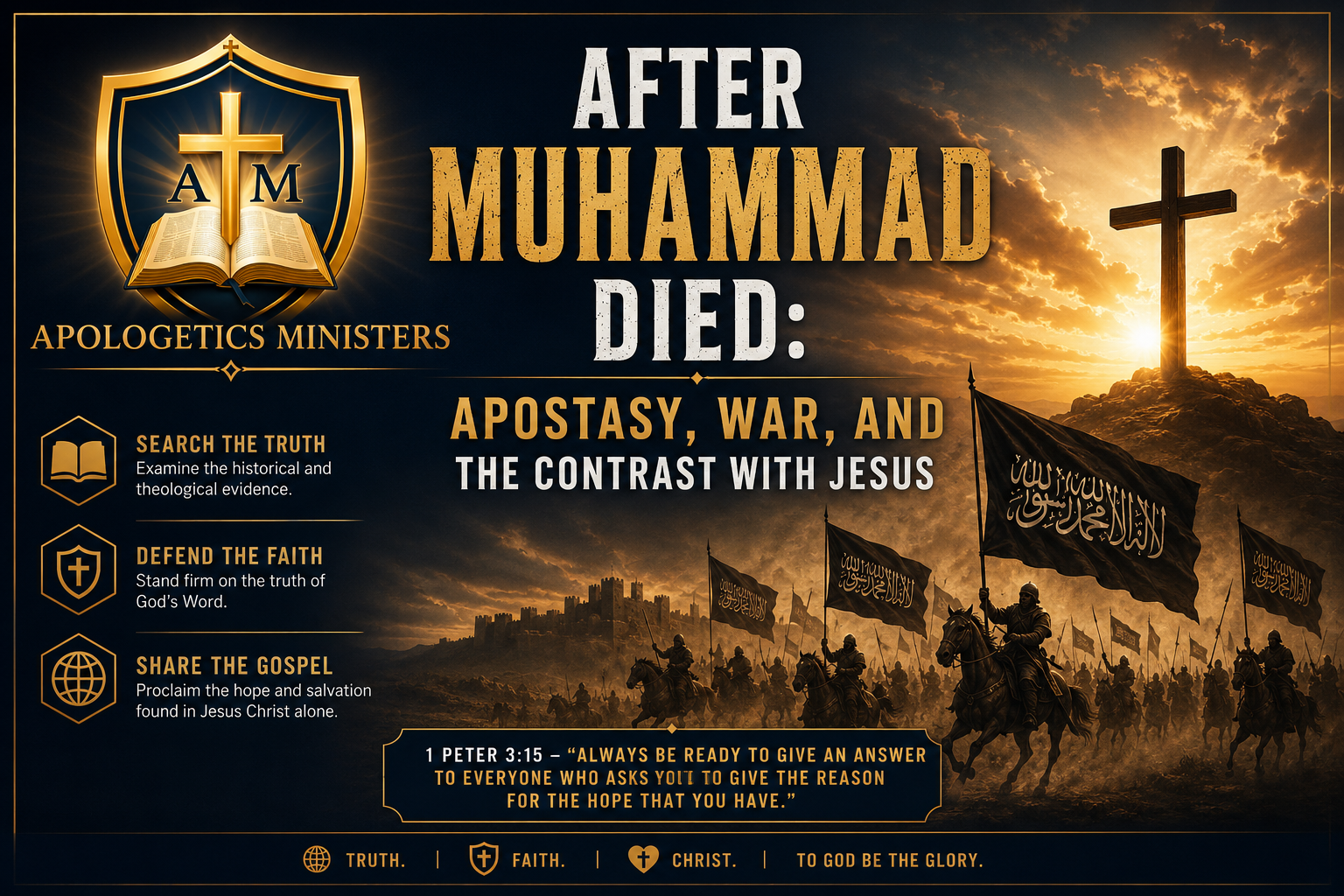

After Muhammad Died: Apostasy, War, and the Contrast with Jesus
The death of Muhammad created one of the greatest crises in early Islamic history. Many modern Muslims speak about the early Islamic community as if it was fully united and spiritually convinced during Muhammad’s lifetime. However, early Islamic sources themselves paint a far more complicated picture. According to major Muslim historians and commentators, many Arab tribes abandoned Islam almost immediately after Muhammad died. Some refused to pay zakat. Others followed new prophets. Some rebelled politically. The result was a series of violent conflicts known in Islamic history as the Ridda Wars.
One of the most important sources describing these events is the tafsir of Muhammad ibn Jarir al-Tabari. In his explanation of Qur’an 5:54, al-Tabari records reports stating that the verse referred to Abu Bakr and his companions fighting the apostates after Muhammad’s death. One narration even says that “most of the Arabs apostatized from Islam” after Muhammad died. Another report states that Abu Bakr captured, killed, and burned apostates who refused to submit and pay zakat.
These reports raise important historical and theological questions. Why did so many tribes abandon Islam immediately after Muhammad’s death? Why did the first caliph believe war was necessary to preserve the religion? Why was refusal to pay zakat treated as apostasy deserving military punishment? Most importantly for Christians, how does this compare with the teachings and example of Jesus Christ?
The contrast between Abu Bakr and Jesus is one of the clearest differences between early Islam and Christianity. In the Islamic tradition, apostasy was met with military force. In the ministry of Jesus, rejection was met with patience, invitation, sorrow, and mercy. While Abu Bakr fought those who left Islam, Jesus allowed people to walk away from Him freely. This contrast reveals two very different visions of religious authority, spiritual leadership, and the spread of faith.
The Crisis After Muhammad’s Death
Muhammad died in 632 AD. His death shocked the Muslim community. For many followers, he was not only a prophet but also a political leader, military commander, judge, and unifying figure for Arabia. Once he died, the unity he created began to weaken rapidly.
According to early Islamic sources, many tribes that had submitted to Muhammad reconsidered their loyalty after his death. Some tribes believed their agreement had been with Muhammad personally and not with the broader Islamic state. Others refused to continue paying zakat to Medina. Some followed new prophetic figures such as Musaylimah, Tulayhah, and Sajah. These movements threatened the survival of the new Islamic order.
In Tafsir al-Tabari, Qatadah is quoted as saying:
“When Allah took His Prophet Muhammad, peace and blessings be upon him, most of the Arabs apostatized from Islam, except for three mosques: the people of Medina, the people of Mecca, and the people of Bahrain from the tribe of Abd al-Qays.”
This statement is remarkable because it comes from within the Islamic tradition itself. It openly admits widespread apostasy after Muhammad’s death. This challenges the popular idea that Arabia had become permanently and spiritually committed to Islam before Muhammad died.
The apostasy crisis was so serious that the survival of the Islamic state was uncertain. Abu Bakr, the first caliph, faced enormous pressure. Some companions reportedly advised compromise with the tribes who refused zakat. Since those tribes still claimed to pray and maintain some connection to Islam, some Muslims argued that war should be avoided.
But Abu Bakr refused compromise. According to the narration, he declared:
“I will not separate what God has joined together.”
He insisted that prayer and zakat were inseparable obligations. Refusing zakat was therefore rebellion against Islam itself. Abu Bakr even stated that if the tribes withheld “even a camel’s hobble” that was due to the Islamic state, he would fight them for it.
This decision led directly to the Ridda Wars.
The Ridda Wars and the Use of Force
The Ridda Wars were military campaigns launched by Abu Bakr to defeat tribes that had rebelled or abandoned Islam after Muhammad’s death. These wars became foundational in Islamic history because they preserved the unity of the early caliphate and paved the way for later Islamic expansion.
Islamic historians describe these wars in great detail. The armies of the caliphate fought rebels across Arabia. Many were killed. Tribes were subdued and brought back under Islamic authority.
One of the strongest parts of the Tabari narration states:
“He captured, killed, and burned with fire people who had apostatized from Islam and refused to pay zakat.”
This statement is deeply important because it demonstrates how apostasy was treated in early Islamic history. The narration does not merely describe theological disagreement. It describes military enforcement, executions, and even burning.
Some Muslims today argue that apostasy laws developed later in Islamic history. However, the Ridda Wars show that the issue goes back to the earliest generation after Muhammad. Abu Bakr himself treated apostasy as a crime serious enough to justify war.
This is also connected to hadith found in Sahih al-Bukhari where Muhammad reportedly said:
“Whoever changes his religion, kill him.”
This hadith later became central to classical Islamic law on apostasy. Although Muslim scholars debated details and conditions, the general principle remained influential in many schools of Islamic jurisprudence.
The Ridda Wars therefore became more than political conflicts. They shaped Islamic theology and law. They established the idea that leaving Islam or refusing major obligations could be punished by force.
Jesus and the Freedom to Reject Him
When Christians compare these events with the teachings of Jesus, the contrast is striking.
Jesus Christ never commanded His followers to kill those who abandoned Him. He never organized military campaigns against unbelievers. He never enforced faith through taxation or warfare.
In fact, the New Testament repeatedly shows Jesus allowing people to reject Him freely.
One of the clearest examples appears in the Gospel of John. After Jesus gave difficult teachings, many disciples stopped following Him. John 6:66 says:
“From that time many of His disciples went back and walked with Him no more.”
This was a major moment of rejection. Jesus had followers leaving Him openly. Yet He did not threaten them, punish them, or send His disciples after them. Instead, He turned to the twelve apostles and simply asked:
“Will you also go away?”
This response is profoundly different from the response seen in the Ridda Wars. Jesus respected the freedom of people to leave. His kingdom was not maintained by force.
Another example appears in Luke 9:54–56. When a Samaritan village rejected Jesus, two disciples became angry and asked:
“Lord, do You want us to command fire to come down from heaven and consume them?”
But Jesus rebuked them. According to many manuscripts, He replied:
“The Son of Man did not come to destroy men’s lives but to save them.”
This passage is extremely important in comparing Christianity and early Islam. Jesus explicitly rejected violent retaliation against those who rejected Him.
Imagine the contrast. In the Ridda Wars, apostasy was answered with armies. In the Gospels, rejection was answered with mercy.
Jesus also taught:
“Love your enemies, bless those who curse you, do good to those who hate you.” (Matthew 5:44)
This teaching shaped the earliest Christian movement. The apostles preached under persecution. Christians were imprisoned, tortured, and killed by Roman authorities. Yet the New Testament never commands believers to execute apostates or wage war to preserve the faith.
Instead, Christianity spread through preaching, sacrifice, charity, and martyrdom.
Different Foundations of Religious Authority
The contrast between Abu Bakr and Jesus reflects a deeper difference between Islam and Christianity.
In early Islam, religion and state were deeply united. Muhammad was both prophet and ruler. Loyalty to Islam involved political submission, religious obedience, and financial obligations. Refusing zakat was not viewed merely as a private spiritual matter. It was seen as rebellion against the Islamic order.
As a result, apostasy became both a religious and political offense.
This explains why Abu Bakr saw military force as necessary. If tribes could freely abandon Islam or refuse zakat, the caliphate itself could collapse. Islam in Arabia was tied to a growing political system.
Christianity began very differently.
Jesus did not establish an earthly state. He did not create a tax system backed by military power. He told Pontius Pilate:
“My kingdom is not of this world.” (John 18:36)
This statement is foundational. Jesus separated His mission from earthly political domination. His kingdom spread through spiritual transformation, not conquest.
The apostles continued this pattern. Paul wrote:
“The weapons of our warfare are not carnal.” (2 Corinthians 10:4)
Christians believed faith must be voluntary because true conversion comes from the heart, not from force.
This difference shaped the development of both religions. Islam rapidly became a political empire. Christianity, for its first three centuries, existed mainly as a persecuted minority without military power.
The Question of Coercion
One of the most difficult questions raised by the Ridda Wars is the issue of coercion in religion.
Can faith be genuine if maintained by force?
The Ridda Wars suggest that early Islamic leadership believed coercion was sometimes necessary to preserve religious unity. Tribes that refused zakat were fought militarily until they submitted again.
The Tabari narration says:
“He fought them until they acknowledged the obligation of zakat, albeit in humiliation and submission.”
The language of humiliation and submission is important. It reflects political domination rather than voluntary conviction.
By contrast, Jesus consistently invited rather than compelled. He warned people about judgment and called for repentance, but He never forced belief.
In Revelation 3:20, Jesus says:
“Behold, I stand at the door and knock.”
The image is not one of forced entry but invitation.
Even when betrayed by Judas Iscariot, Jesus did not order his execution. When Peter the Apostle used a sword during Jesus’ arrest, Jesus rebuked him and healed the wounded man.
Again and again, Jesus rejected violent enforcement of His mission.
Why Did So Many Leave Islam?
The Ridda Wars also raise historical questions about the nature of early Islamic conversions.
If “most of the Arabs apostatized,” as the narration claims, what does this say about the spread of Islam during Muhammad’s lifetime?
Some historians argue that many tribes may have submitted politically rather than spiritually. Arabia had been united under Muhammad’s leadership, but after his death many tribes reconsidered their allegiance.
This suggests that Islam’s early expansion involved a strong political dimension. Loyalty to Muhammad may not always have reflected deep personal conviction.
In Christianity, the situation was different. Following Jesus often brought suffering rather than political advantage. Early Christians faced persecution from both Jewish and Roman authorities. Becoming Christian could lead to imprisonment or death.
This does not prove Christianity true and Islam false automatically. However, it does highlight a major historical contrast. Christianity initially spread without military power, while Islam quickly became tied to state authority and armed enforcement.
Apostasy in Christian Teaching
The New Testament also discusses apostasy, but its response is spiritual rather than violent.
Christians are warned against falling away from faith. The book of Hebrews contains serious warnings about apostasy. Paul warned against false teachers and spiritual deception.
However, the response was never execution.
Church discipline in the New Testament involved correction, rebuke, exclusion from fellowship, and calls to repentance. The goal was restoration, not killing.
For example, in 2 Timothy 2:24–25, Paul wrote:
“The servant of the Lord must not quarrel but be gentle to all… in humility correcting those who are in opposition.”
This spirit is very different from military suppression.
Even when Christians later became politically powerful after the Roman Empire adopted Christianity, the example of Jesus remained a challenge to coercive religion. Many Christians throughout history have pointed back to Jesus’ teachings to criticize violence done in the name of religion.
The Character of Jesus Compared with the Caliphate
The contrast between Jesus and the early caliphate also reflects different models of leadership.
Jesus washed the feet of His disciples. He taught humility and self-sacrifice. He accepted crucifixion rather than calling armies to defend Him.
Abu Bakr, on the other hand, ruled a growing state facing rebellion and fragmentation. His actions reflected political leadership as well as religious authority.
Muslims often praise Abu Bakr for saving Islam during the Ridda Wars. From the Islamic perspective, his actions preserved the Muslim community from collapse.
But Christians ask a different question: would Jesus have acted the same way?
The evidence of the Gospels strongly suggests the answer is no.
Jesus never indicated that His followers should preserve the faith through military force. Instead, He predicted persecution and called His followers to endure suffering faithfully.
This difference matters deeply because Christians believe Jesus perfectly reveals the character of God.
If Jesus rejected violence against rejecters and apostates, Christians see this as revealing God’s true approach toward human freedom and faith.
The Expansion of Islam After the Ridda Wars
The Ridda Wars did not merely preserve the caliphate. They also prepared the way for massive Islamic expansion beyond Arabia.
Once Arabia was united again under Abu Bakr, Muslim armies moved outward into Byzantine and Persian territories. Within decades, vast regions came under Islamic rule.
The Ridda Wars therefore became the foundation for the Islamic empire.
This historical reality further strengthens the contrast with Christianity. The early Christian movement expanded primarily through missionary preaching and witness. Christians died as martyrs rather than conquering territories.
Of course, later Christian history also includes violence and political abuses. Christians have sometimes acted contrary to Jesus’ teachings. However, the key question is not merely what later followers did, but what the founders themselves taught and modeled.
Jesus never commanded crusades, apostasy executions, or military conquest.
The Ridda Wars, however, were carried out by the closest companions of Muhammad and were later celebrated in mainstream Islamic history.
The Meaning of Freedom in Faith
At the center of this discussion is the issue of freedom.
Can true faith exist without freedom to reject?
Jesus allowed rejection because love and faith cannot be forced. A coerced believer is not truly transformed inwardly.
This does not mean Jesus treated truth lightly. He spoke strongly about judgment, repentance, and salvation. But He allowed individuals to choose.
The Islamic approach during the Ridda Wars reflected a different understanding. Religious unity and political stability were considered essential to the survival of the Muslim community. Apostasy therefore became a public danger rather than merely a personal decision.
This produced very different civilizations and legal traditions.
In many classical Islamic societies, apostasy laws remained part of legal thought. In Christian theology, however, faith was increasingly understood as something that must be embraced voluntarily.
Conclusion
The apostasy crisis after Muhammad’s death reveals one of the most important turning points in Islamic history. Early Islamic sources such as Tafsir al-Tabari openly state that many Arabs abandoned Islam after Muhammad died. Abu Bakr responded with military force, fighting tribes until they returned to submission and paid zakat.
These events shaped Islamic law, politics, and theology for centuries. Apostasy became closely connected with rebellion against the Islamic state. Force was used to preserve unity.
When compared with Jesus Christ, the contrast is striking. Jesus allowed people to reject Him. He rebuked violence against opponents. He taught love for enemies and refused to build an earthly kingdom through military power.
The Ridda Wars and the teachings of Jesus therefore present two very different visions of religious authority. One used warfare to maintain religious unity. The other relied on persuasion, sacrifice, and voluntary faith.
For Christians, this contrast is deeply significant. It raises questions not only about history but also about the nature of God, the meaning of faith, and the proper response to those who reject religious truth.